Ch.3 - Mass Relationships in Chemical Reactions
McMurry - Chemistry 8th Edition
McMurry8th EditionChemistryISBN: 9781292336145당신이 사용하는 게 아니라요?교과서 변경
3장, 문제 9

If 2.00 moles of nitrogen and 5.50 moles of hydrogen are placed in a reaction vessel and react to form ammonia, what is the theoretical yield of ammonia (NH3)? (LO 3.8) N2(g) + 3 H2(g) --> 2 NH3(g) (a) 31.2 g (b) 62.3 g (c) 93.7 g (d) 34.1

검증된 단계별 안내
1
Identify the balanced chemical equation: \( N_2(g) + 3 H_2(g) \rightarrow 2 NH_3(g) \).
Determine the limiting reactant by comparing the mole ratio of \( N_2 \) and \( H_2 \) to the coefficients in the balanced equation.
Calculate the moles of \( NH_3 \) produced by the limiting reactant using stoichiometry.
Convert the moles of \( NH_3 \) to grams using the molar mass of \( NH_3 \) (17.03 g/mol).
Compare the calculated mass of \( NH_3 \) to the given options to determine the theoretical yield.

비슷한 문제에 대한 검증된 영상 답변:

이 영상 해법은 위 문제에 도움이 된다고 튜터들이 추천한 것입니다.
영상 길이:
2m

주요 개념

질문에 올바르게 답하기 위해 반드시 이해해야 하는 핵심 개념들은 다음과 같습니다.

Stoichiometry

Stoichiometry is the branch of chemistry that deals with the quantitative relationships between reactants and products in a chemical reaction. It allows us to calculate the amounts of substances consumed and produced in a reaction based on balanced chemical equations. In this case, the stoichiometric coefficients from the balanced equation indicate the molar ratios needed to determine the theoretical yield of ammonia.
추천 영상:
가이드 코스
01:16
Stoichiometry Concept

Limiting Reactant

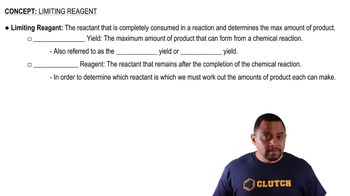
The limiting reactant is the substance that is completely consumed first in a chemical reaction, thus determining the maximum amount of product that can be formed. In the given reaction, we need to identify whether nitrogen or hydrogen is the limiting reactant by comparing the mole ratios of the reactants to the coefficients in the balanced equation. This concept is crucial for calculating the theoretical yield of ammonia.
추천 영상:
가이드 코스
01:30
Limiting Reagent Concept

Molar Mass

Molar mass is the mass of one mole of a substance, typically expressed in grams per mole (g/mol). To convert the number of moles of ammonia produced into grams, we must use the molar mass of ammonia (NH3), which is approximately 17.03 g/mol. This conversion is essential for expressing the theoretical yield in grams, as required by the question.
추천 영상:
가이드 코스
02:11
Molar Mass Concept
관련 실천
교과서 질문
If 42.85 grams of salicylic acid reacts with excess acetic anhydride and produces 48.47 grams of aspirin, what is the percent yield of the reaction? (LO 3.6) (a) 88.40% (b) 64.69% (c) 86.72% (d) 78.74%
852
views

교과서 질문
What is the percent composition by mass of Mn in potas-sium permanganate, KMnO4? (LO 3.10) (a) 22.6% (b) 34.8% (c) 49.9% (d) 54.9%
651
views
교과서 질문

Silver sulfide, the tarnish on silverware, comes from the reaction of silver metal with hydrogen sulfide (H2S).The unbalanced equation is: Ag + H2S + O2 --> Ag2S + H2O Unbalanced If the reaction was used intentionally to prepare Ag2S, how many grams would be formed from 496 g of Ag, 80.0 g of H2S, and excess O2 if the reaction takes place in 90% yield? (LO 3.9) (a) 525 g (b) 1139 g (c) 583 g (d) 1025

1742
views
교과서 질문

Dimethylhydrazine, a colorless liquid used as a rocket fuel, is 40.0% C, 13.3% H, and 46.7% N. What is the empirical formula? (LO 3.11) (a) CH4N9 (b) CH2N (c) C2H4N (d) C2H5N2

1050
views
교과서 질문
The diagram represents a mixture of AB2 and B2 before it reacts to form AB3. (Red spheres = A, blue spheres = B.) Which reactant is limiting, and how many AB3 molecules are formed? (LO 3.7)

(a) B2 is limiting, and 10 molecules of AB3 are formed. (b) B2 is limiting, and 4 molecules of AB3 are formed. (c) AB2 is limiting, and 6 molecules of AB3 are formed. (d) AB2 is limiting, and 4 molecules of AB3 are formed
571
views
교과서 질문
One way to make coal burning better for the environment is to remove carbon dioxide from the exhaust gases released from power plants using a compound containing an amine (-NH2) group. The reaction between carbon dioxide and monoethanolamine is: CO2(g) + 2 HOCH2CH2NH2(aq) -> HOCH2CH2NH3 +(aq) + HOCH2CH2NHCO2-(aq) What mass of monoethanoloamine is required to react with 1.0 kg of carbon dioxide? (LO 3.5) (a) 2.8 kg (b) 1.1 kg (c) 0.93 kg (d) 0.53 kg
673
views