An alternative method for producing hydriodic acid is the reaction of iodine with hydrogen sulfide: H2S + I2 → 2 HI + S (a) How many grams of I2 are needed to react with 49.2 g of H2S?
Ch.3 - Mass Relationships in Chemical Reactions
3장, 문제 72a
Nickel(II) sulfate, used for nickel plating, is prepared by treat-ment of nickel(II) carbonate with sulfuric acid: NiCO3 + H2SO4 → NiSO4 + CO2 + H2O (a) How many grams of H2SO4 are needed to react with 14.5 g of NiCO3?
검증된 단계별 안내1
Determine the molar mass of NiCO_3 by adding the atomic masses of Ni, C, and O_3.
Calculate the number of moles of NiCO_3 using the formula: \( \text{moles} = \frac{\text{mass}}{\text{molar mass}} \).
Use the balanced chemical equation to find the mole ratio between NiCO_3 and H_2SO_4, which is 1:1.
Calculate the number of moles of H_2SO_4 needed using the mole ratio from the balanced equation.
Determine the mass of H_2SO_4 required by multiplying the number of moles of H_2SO_4 by its molar mass.

비슷한 문제에 대한 검증된 영상 답변:
이 영상 해법은 위 문제에 도움이 된다고 튜터들이 추천한 것입니다.
영상 길이:
2m주요 개념
질문에 올바르게 답하기 위해 반드시 이해해야 하는 핵심 개념들은 다음과 같습니다.
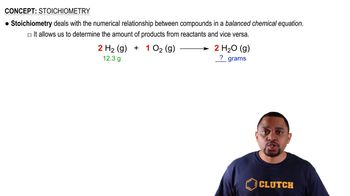
Stoichiometry
Stoichiometry is the calculation of reactants and products in chemical reactions based on the balanced chemical equation. It involves using mole ratios derived from the coefficients of the balanced equation to determine the amount of substances consumed or produced. Understanding stoichiometry is essential for solving problems related to the quantities of reactants and products in a reaction.
추천 영상:
가이드 코스
Stoichiometry Concept
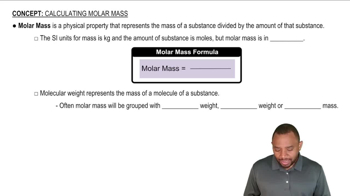
Molar Mass
Molar mass is the mass of one mole of a substance, typically expressed in grams per mole (g/mol). It is calculated by summing the atomic masses of all atoms in a molecule. Knowing the molar mass of reactants and products is crucial for converting between grams and moles, which is necessary for stoichiometric calculations in chemical reactions.
추천 영상:
가이드 코스
Molar Mass Concept
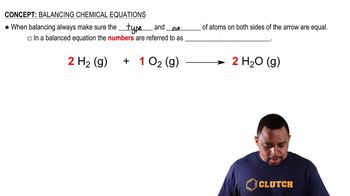
Balanced Chemical Equation
A balanced chemical equation represents a chemical reaction with equal numbers of each type of atom on both sides of the equation. Balancing ensures the law of conservation of mass is upheld, meaning matter is neither created nor destroyed in a reaction. This balanced equation provides the necessary mole ratios for stoichiometric calculations, allowing for accurate predictions of reactant and product amounts.
추천 영상:
가이드 코스
Balancing Chemical Equations
관련 실천
교과서 질문
501
views
교과서 질문
Nickel(II) sulfate, used for nickel plating, is prepared by treat-ment of nickel(II) carbonate with sulfuric acid: NiCO3 + H2SO4 → NiSO4 + CO2 + H2O
(b) How many grams of NiSO4 are obtained if the yield is 78.9%?
962
views
교과서 질문
The industrial production of hydriodic acid takes place by treatment of iodine with hydrazine (N2H4):
2 I2 + N2H4 --> 4 HI + N2
(b) How many grams of HI are produced from the reaction of 115.7 g of N2H4 with excess iodine
722
views
교과서 질문
An alternative method for producing hydriodic acid is the reaction of iodine with hydrogen sulfide:H2S + I2 → 2 HI + S (b) How many grams of HI are produced from the reaction of 95.4 g of H2S with excess I2?
461
views
교과서 질문
Hydrazine, N2H4, once used as a rocket propellant, reacts with oxygen: N2H4 + O2 → N2 + 2 H2O (a) How many grams of O2 are needed to react with 50.0 g of N2H4?
1276
views
교과서 질문
Hydrazine, N2H4, once used as a rocket propellant, reacts with oxygen: N2H4 + O2 → N2 + 2 H2O (b) How many grams of N2 are obtained if the yield is 85.5%?
1310
views