Ch.3 - Mass Relationships in Chemical Reactions
McMurry - Chemistry 8th Edition
McMurry8th EditionChemistryISBN: 9781292336145당신이 사용하는 게 아니라요?교과서 변경
3장, 문제 47

The following pictures represent equilibrium mixtures at 325 K and 350 K for a reaction involving A atoms (red), B atoms (blue), and AB molecules. (a) Write a balanced equation for the reaction that occurs on raising the temperature.

검증된 단계별 안내
1
Identify the components involved in the reaction: A atoms (red), B atoms (blue), and AB molecules.
Determine the initial and final states of the reaction at the given temperatures (325 K and 350 K) by analyzing the pictures.
Observe the change in the number of A atoms, B atoms, and AB molecules as the temperature increases from 325 K to 350 K.
Write the balanced chemical equation based on the observed changes, ensuring that the number of atoms of each element is conserved.
Consider the direction of the reaction that is favored by the increase in temperature, indicating whether the reaction is endothermic or exothermic.

비슷한 문제에 대한 검증된 영상 답변:

이 영상 해법은 위 문제에 도움이 된다고 튜터들이 추천한 것입니다.
영상 길이:
1m

주요 개념

질문에 올바르게 답하기 위해 반드시 이해해야 하는 핵심 개념들은 다음과 같습니다.

Chemical Equilibrium

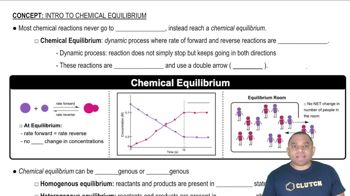
Chemical equilibrium occurs when the rates of the forward and reverse reactions are equal, resulting in constant concentrations of reactants and products. In this state, the system is dynamic, meaning that reactions continue to occur, but there is no net change in the concentrations. Understanding this concept is crucial for analyzing how changes in conditions, such as temperature, affect the position of equilibrium.
추천 영상:
가이드 코스
04:21
Chemical Equilibrium Concepts

Le Chatelier's Principle

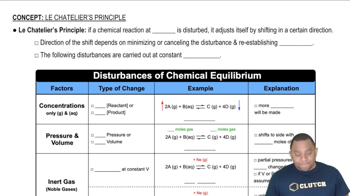
Le Chatelier's Principle states that if a dynamic equilibrium is disturbed by changing the conditions, the system will adjust to counteract the change and restore a new equilibrium. For example, increasing the temperature of an exothermic reaction will shift the equilibrium position to favor the endothermic direction, thus affecting the concentrations of reactants and products. This principle is essential for predicting the effects of temperature changes on chemical reactions.
추천 영상:
가이드 코스
07:32
Le Chatelier's Principle

Balanced Chemical Equation

A balanced chemical equation represents a chemical reaction with equal numbers of each type of atom on both sides of the equation, adhering to the law of conservation of mass. Balancing equations is crucial for understanding the stoichiometry of reactions, which informs how reactants convert to products. In the context of the question, writing a balanced equation for the reaction at different temperatures requires knowledge of the reactants and products involved.
추천 영상:
가이드 코스
01:32
Balancing Chemical Equations