
Ch.3 - Mass Relationships in Chemical Reactions
McMurry - Chemistry 8th Edition
McMurry8th EditionChemistryISBN: 9781292336145당신이 사용하는 게 아니라요?교과서 변경
3장, 문제 15

Which of the following compounds is incorrectly named? (LO 2.23–2.25) (a) CaO; calcium oxide (b) FeBr2; iron dibromide (c) N2O5; dinitrogen pentoxide (d) CrO3; chromium(VI) oxide

검증된 단계별 안내
1
Identify the type of compound for each option: ionic or covalent.
For ionic compounds, check if the metal can have multiple oxidation states and if the name reflects the correct oxidation state.
For covalent compounds, ensure the use of prefixes to indicate the number of atoms of each element.
Examine option (b) FeBr2: Iron can have multiple oxidation states, so the name should include the oxidation state of iron.
Determine the correct name for FeBr2 by identifying the oxidation state of iron and using the appropriate Roman numeral.

비슷한 문제에 대한 검증된 영상 답변:

이 영상 해법은 위 문제에 도움이 된다고 튜터들이 추천한 것입니다.
영상 길이:
2m

주요 개념

질문에 올바르게 답하기 위해 반드시 이해해야 하는 핵심 개념들은 다음과 같습니다.

Ionic Compounds

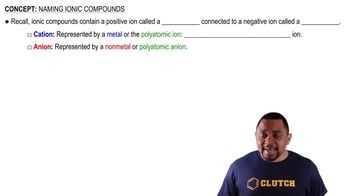
Ionic compounds are formed from the electrostatic attraction between positively charged cations and negatively charged anions. The naming convention typically involves stating the name of the cation first, followed by the anion with its suffix modified to '-ide' for simple anions. Understanding how to identify and name these compounds is crucial for determining the correctness of compound names.
추천 영상:
가이드 코스
02:11
Ionic Compounds Naming

Naming Transition Metals

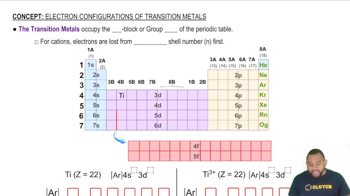
Transition metals can have multiple oxidation states, which necessitates the use of Roman numerals in their names to indicate the specific charge of the metal ion in a compound. For example, in iron(II) bromide (FeBr2), the Roman numeral II indicates that iron has a +2 charge. This concept is essential for accurately naming compounds that include transition metals.
추천 영상:
가이드 코스
03:12
Transition Metals

Molecular Compounds

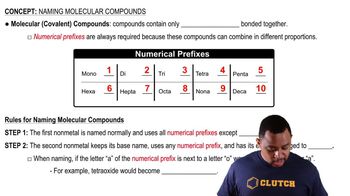
Molecular compounds are formed when two or more nonmetals bond covalently, sharing electrons. Their naming involves using prefixes to denote the number of atoms of each element present in the compound, such as 'di-' for two and 'pent-' for five. Recognizing the difference between ionic and molecular compounds is key to understanding the naming conventions applied in the question.
추천 영상:
가이드 코스
02:06
Naming Molecular Compounds