

Ch.4 - Reactions in Aqueous Solution
McMurry - Chemistry 8th Edition
McMurry8th EditionChemistryISBN: 9781292336145당신이 사용하는 게 아니라요?교과서 변경
4장, 문제 152

Assume that you dissolve 10.0 g of a mixture of NaOH and Ba(OH)2 in 250.0 mL of water and titrate with 1.50 M hydrochloric acid. The titration is complete after 108.9 mL of the acid has been added. What is the mass in grams of each substance in the mixture?

검증된 단계별 안내
1
Determine the total moles of HCl used in the titration. Since the concentration of HCl is given as 1.50 M, and the volume used is 108.9 mL, convert the volume from mL to L and use the formula: Moles of HCl = Molarity of HCl × Volume of HCl in liters.
Write the balanced chemical equations for the reaction of HCl with NaOH and Ba(OH)2. For NaOH: HCl + NaOH → NaCl + H2O. For Ba(OH)2: 2 HCl + Ba(OH)2 → BaCl2 + 2 H2O.
Set up the stoichiometry based on the balanced equations. Since each mole of NaOH reacts with 1 mole of HCl and each mole of Ba(OH)2 reacts with 2 moles of HCl, use these ratios to express the moles of NaOH and Ba(OH)2 in terms of the moles of HCl.
Let x be the moles of NaOH and y be the moles of Ba(OH)2 in the mixture. Set up the equation x + 2y = total moles of HCl (from step 1) to account for all the HCl reacted.
Use the mass of the mixture (10.0 g) and the molar masses of NaOH and Ba(OH)2 to set up another equation: (Molar mass of NaOH) × x + (Molar mass of Ba(OH)2) × y = 10.0 g. Solve the system of equations from steps 4 and 5 to find the values of x and y, and then convert these moles back to grams to find the mass of each substance in the mixture.

비슷한 문제에 대한 검증된 영상 답변:

이 영상 해법은 위 문제에 도움이 된다고 튜터들이 추천한 것입니다.
영상 길이:
5m

주요 개념

질문에 올바르게 답하기 위해 반드시 이해해야 하는 핵심 개념들은 다음과 같습니다.

Stoichiometry

Stoichiometry is the calculation of reactants and products in chemical reactions. It involves using balanced chemical equations to determine the relationships between the amounts of substances consumed and produced. In this question, stoichiometry will help relate the moles of hydrochloric acid used in the titration to the moles of NaOH and Ba(OH)2 in the mixture.
추천 영상:
가이드 코스
01:16
Stoichiometry Concept

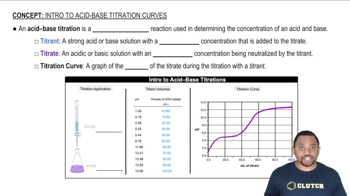
Titration

Titration is a quantitative analytical technique used to determine the concentration of a solute in a solution. It involves the gradual addition of a titrant (in this case, hydrochloric acid) to a solution until the reaction reaches completion, indicated by a color change or a specific endpoint. Understanding the titration process is essential for calculating the amounts of NaOH and Ba(OH)2 in the mixture based on the volume and concentration of the acid used.
추천 영상:
가이드 코스
03:04
Acid-Base Titration

Molarity and Moles

Molarity is a measure of concentration defined as the number of moles of solute per liter of solution. To solve the problem, it is necessary to convert the volume of hydrochloric acid used in the titration into moles, which can then be used to find the moles of NaOH and Ba(OH)2. This concept is crucial for determining the mass of each component in the original mixture.
추천 영상:
관련 실천
교과서 질문
Four solutions are prepared and mixed in the following order: (a) Start with 100.0 mL of 0.100 M BaCl2 (b) Add 50.0 mL of 0.100 M AgNO3 (c) Add 50.0 mL of 0.100 M H2SO4 (d) Add 250.0 mL of 0.100 M NH3. Write an equation for any reaction that occurs after each step, and calculate the concentrations of Ba2+, Cl-, NO3-, NH3, and NH4+ in the final solution, assuming that all reactions go to completion.
840
views
교과서 질문

Element M is prepared industrially by a two-step procedure according to the following (unbalanced) equations:

Assume that 0.855 g of M2O3 is submitted to the reaction sequence. When the HCl produced in step (2) is dissolved in water and titrated with 0.511 M NaOH, 144.2 mL of the NaOH solution is required to neutralize the HCl. (a) Balance both equations.

455
views
교과서 질문

To 100.0 mL of a solution that contains 0.120 M Cr(NO3)2 and 0.500 M HNO3 is added to 20.0 mL of 0.250 M K2Cr2O7. The dichromate and chromium(II) ions react to give chromium(III) ions. (a) Write a balanced net ionic equation for the reaction.

477
views
교과서 질문

A 1.268 g sample of a metal carbonate (MCO3) was treated with 100.00 mL of 0.1083 M sulfuric acid (H2SO4), yielding CO2 gas and an aqueous solution of the metal sulfate (MSO4). The solution was boiled to remove all the dissolved CO2 and was then titrated with 0.1241 M NaOH. A 71.02 mL volume of NaOH was required to neutralize the excess H2SO4. (a) What is the identity of the metal M?

524
views
교과서 질문

(b) How many liters of CO2 gas were produced if the density of CO2 is 1.799 g/L?

719
views
교과서 질문

(b) Calculate the concentrations of all ions in the solution after reaction. Check your concentrations to make sure that the solution is electrically neutral.

847
views