
Ch.5 - Periodicity & Electronic Structure of Atoms
McMurry - Chemistry 8th Edition
McMurry8th EditionChemistryISBN: 9781292336145당신이 사용하는 게 아니라요?교과서 변경
5장, 문제 136a

A minimum energy of 7.21⨉10-19 J is required to produce the photoelectric effect in chromium metal. (a) What is the minimum frequency of light needed to remove an electron from chromium?

검증된 단계별 안내
1
Identify the equation that relates the energy of a photon to its frequency. The equation is given by Planck's equation: E = h \(\nu\), where E is the energy of the photon, h is Planck's constant (6.626 x 10^{-34} J\(\cdot\) s), and \(\nu\) is the frequency of the photon.
Rearrange the equation to solve for the frequency (\(\nu\)). The rearranged equation is \(\nu\) = \(\frac{E}{h}\).
Substitute the given energy value (7.21 x 10^{-19} J) into the rearranged equation.
Perform the division to calculate the frequency. Ensure that the units of Planck's constant (Joule seconds) are correctly aligned with the units of energy (Joules) so that they cancel out appropriately, leaving the frequency in units of s^{-1}, which is also known as Hertz (Hz).
Interpret the result as the minimum frequency of light required to eject an electron from chromium, thus causing the photoelectric effect.

비슷한 문제에 대한 검증된 영상 답변:

이 영상 해법은 위 문제에 도움이 된다고 튜터들이 추천한 것입니다.
영상 길이:
1m

주요 개념

질문에 올바르게 답하기 위해 반드시 이해해야 하는 핵심 개념들은 다음과 같습니다.

Photoelectric Effect

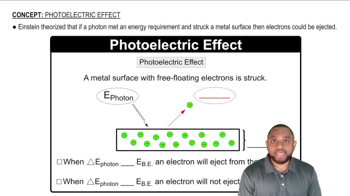
The photoelectric effect refers to the phenomenon where electrons are emitted from a material when it absorbs light of sufficient energy. This effect demonstrates the particle nature of light, where photons, the light particles, must have enough energy to overcome the work function of the material to release electrons.
추천 영상:
가이드 코스
02:31
Photoelectric Effect

Energy-Frequency Relationship

The energy of a photon is directly related to its frequency through the equation E = hν, where E is energy, h is Planck's constant (6.626 × 10^-34 J·s), and ν (nu) is the frequency of the light. This relationship allows us to calculate the minimum frequency required to achieve a specific energy threshold, such as that needed for the photoelectric effect.
추천 영상:
가이드 코스
00:31
Frequency-Wavelength Relationship

Work Function

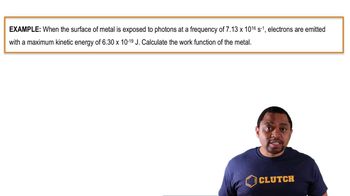
The work function is the minimum energy required to remove an electron from the surface of a material. It is a characteristic property of each material and is crucial in determining the threshold frequency of light needed to initiate the photoelectric effect. For chromium, this value is given as 7.21 × 10^-19 J.
추천 영상:
가이드 코스
01:52
Work Function Calculation Example
관련 실천
교과서 질문
X rays with a wavelength of 1.54 * 10-10 m are produced when a copper metal target is bombarded with high-energy electrons that have been accelerated by a voltage difference of 30,000 V. The kinetic energy of the electrons equals the product of the voltage difference and the electronic charge in coulombs, where 1 volt-coulomb = 1 J. (a) What is the kinetic energy in joules and the de Broglie wavelength in meters of an electron that has been accel-erated by a voltage difference of 30,000 V?
724
views
교과서 질문
Assume that the rules for quantum numbers are different and that the spin quantum number ms can have any of three values, ms = -1/2, 0, +1/2, while all other rules remain the same. (a) Draw an orbital-filling diagram for the element with Z = 25, showing the individual electrons in the outer-most subshell as up arrows, down arrows, or 0. How many partially filled orbitals does the element have?
885
views
교과서 질문
(c) What is the velocity of an electron with a de Broglie wavelength equal to (b)?
640
views
교과서 질문

A minimum energy of 7.21⨉10-19 J is required to produce the photoelectric effect in chromium metal. (b) Light with a wavelength of 2.50⨉10-7 m falls on a piece of chromium in an evacuated glass tube. What is the minimum de Broglie wavelength of the emitted electrons? (Note that the energy of the incident light must be conserved; that is, the photon's energy must equal the sum of the energy needed to eject the electron plus the kinetic energy of the electron.)

573
views
교과서 질문
In the Bohr model of atomic structure, electrons are constrained to orbit a nucleus at specific distances, given by the equation

where r is the radius of the orbit, Z is the charge on the nucleus, a0 is the Bohr radius and has a value of 5.292 * 10-11 m, and n is a positive integer (n = 1, 2, 3...) like a principal quantum number. Furthermore, Bohr concluded that the energy level E of an electron in a given orbit is

where e is the charge on an electron. Derive an equation that will let you calculate the difference ∆E between any two energy levels. What relation does your equation have to the Balmer–Rydberg equation?
769
views
교과서 질문

An energetically excited hydrogen atom has its electron in a 5f subshell. The electron drops down to the 3d subshell, releasing a photon in the process. (b) What wavelength of light is emitted by the process?

388
views