
Ch.5 - Periodicity & Electronic Structure of Atoms
McMurry - Chemistry 8th Edition
McMurry8th EditionChemistryISBN: 9781292336145당신이 사용하는 게 아니라요?교과서 변경
5장, 문제 55

Cesium metal is frequently used in photoelectric cells because the amount of energy necessary to eject electrons from a cesium surface is relatively small—only 206.5 kJ/mol. What wavelength of light in nanometers does this correspond to?

검증된 단계별 안내
1
Identify the energy required to eject electrons from the cesium surface, which is given as 206.5 kJ/mol.
Convert the energy from kJ/mol to J/photon. Use the conversion factor: 1 kJ = 1000 J and Avogadro's number (6.022 x 10^23 mol^-1) to find the energy per photon.
Use the equation E = h\(\nu\), where E is the energy per photon, h is Planck's constant (6.626 x 10^-34 J·s), and \(\nu\) is the frequency of the light. Rearrange the equation to solve for \(\nu\): \(\nu\) = E/h.
Use the relationship between frequency and wavelength: c = \(\lambda\)\(\nu\), where c is the speed of light (3.00 x 10^8 m/s) and \(\lambda\) is the wavelength. Rearrange to solve for \(\lambda\): \(\lambda\) = c/\(\nu\).
Convert the wavelength from meters to nanometers by multiplying by 10^9, since 1 meter = 10^9 nanometers.

비슷한 문제에 대한 검증된 영상 답변:

이 영상 해법은 위 문제에 도움이 된다고 튜터들이 추천한 것입니다.
영상 길이:
2m

주요 개념

질문에 올바르게 답하기 위해 반드시 이해해야 하는 핵심 개념들은 다음과 같습니다.

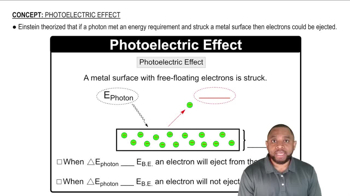
Photoelectric Effect

The photoelectric effect is the phenomenon where electrons are emitted from a material when it absorbs light of sufficient energy. This effect demonstrates the particle nature of light, where photons collide with electrons, providing them enough energy to overcome the material's work function, which is the minimum energy required to eject an electron.
추천 영상:
가이드 코스
02:31
Photoelectric Effect

Energy and Wavelength Relationship

The energy of a photon is inversely related to its wavelength, described by the equation E = hc/λ, where E is energy, h is Planck's constant, c is the speed of light, and λ is the wavelength. This relationship indicates that shorter wavelengths correspond to higher energy photons, which is crucial for understanding how light can cause electron ejection in the photoelectric effect.
추천 영상:
가이드 코스
00:31
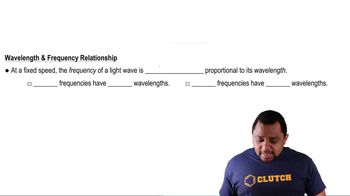
Frequency-Wavelength Relationship

Conversion of Energy Units

In this context, energy is given in kJ/mol, which must be converted to joules per photon for calculations involving individual photons. Since 1 kJ = 1000 J and 1 mol contains Avogadro's number of particles (approximately 6.022 x 10^23), converting kJ/mol to J/photon allows for the application of the energy-wavelength relationship to find the corresponding wavelength of light.
추천 영상:
가이드 코스
01:56
Conversion Factors
관련 실천
교과서 질문
Spectroscopy is a technique that uses the interaction of radiant energy with matter to identify or quantify a substance in a sample. A deuterium lamp is often used a light source in the ultraviolet region of the spectrum and the emission spectrum is shown. Is this a continuous or line emission spectrum?

635
views
교과서 질문
The work function of cesium metal is 188 kJ/mol, which corresponds to light with a wavelength of 637 nm. Which of the following will cause the smallest number of electrons to be ejected from cesium? (a) High-amplitude wave with a wavelength of 500 nm (b) Low-amplitude wave with a wavelength of 500 nm (c) High-amplitude wave with a wavelength of 650 nm (d) Low-amplitude wave with a wavelength of 650 nm
1141
views
교과서 질문
According to the equation for the Balmer line spectrum of hydrogen, a value of n = 3 gives a red spectral line at 656.3 nm, a value of n = 4 gives a green line at 486.1 nm, and a value of n = 5 gives a blue line at 434.0 nm. Calculate the energy in kilojoules per mole of the radiation corresponding to each of these spectral lines.
1660
views
1
rank
교과서 질문
Sodium-vapor lamps are a common source of lighting. The emission spectrum from this type of lamp is shown. Is this a continuous or line emission spectrum?

628
views
교과서 질문
The work function of silver metal is 436 kJ/mol. What frequency of light is needed to eject electrons from a sample of silver?
1067
views
교과서 질문
The work function of calcium metal is kJ/mol, which corresponds to light with a wavelength of 432 nm. Which of the following will cause the largest number of electrons to be ejected from cesium? (a) High-amplitude wave with a wavelength of 400 nm (b) Low-amplitude wave with a wavelength of 400 nm (c) High-amplitude wave with a wavelength of 450 nm (d) Low-amplitude wave with a wavelength of 450 nm
1171
views