Give the allowable combinations of quantum numbers for each of the following electrons.
(a) A 4s electron
(b) A 3p electron
(c) A 5f electron
(d) A 5d electron
검증된 단계별 안내
1
insert step 1
insert step 2
insert step 3
insert step 4
insert step 5
비슷한 문제에 대한 검증된 영상 답변:
이 영상 해법은 위 문제에 도움이 된다고 튜터들이 추천한 것입니다.
영상 길이:
2m
영상 재생:
0 댓글
주요 개념
질문에 올바르게 답하기 위해 반드시 이해해야 하는 핵심 개념들은 다음과 같습니다.
Quantum Numbers
Quantum numbers are sets of numerical values that describe the unique quantum state of an electron in an atom. There are four quantum numbers: the principal quantum number (n), which indicates the energy level; the azimuthal quantum number (l), which defines the subshell; the magnetic quantum number (m_l), which specifies the orientation of the orbital; and the spin quantum number (m_s), which describes the electron's spin direction.
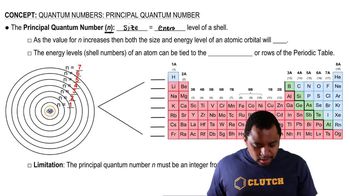
The principal quantum number (n) indicates the main energy level of an electron and can take positive integer values (1, 2, 3, ...). Higher values of n correspond to electrons that are further from the nucleus and have higher energy. For example, a 4s electron has n=4, while a 3p electron has n=3, which affects their energy and spatial distribution.
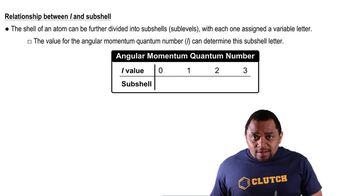
Subshells are defined by the azimuthal quantum number (l), which can take values from 0 to n-1. Each value of l corresponds to a specific subshell: l=0 for s, l=1 for p, l=2 for d, and l=3 for f. The magnetic quantum number (m_l) can take values from -l to +l, determining the number of orbitals within a subshell. For instance, a 5d electron has l=2, allowing for five possible m_l values (-2, -1, 0, +1, +2).


 검증된 단계별 안내
 02:55
02:55