Why does the number of elements in successive periods of the periodic table increase by the progression 2, 8, 18, 32?
검증된 단계별 안내
1
1. The periodic table is organized based on the electron configuration of atoms. The electron configuration of an atom is determined by the distribution of electrons in its atomic orbitals.
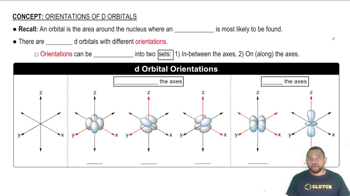
2. The atomic orbitals are grouped into different energy levels or shells, and each shell is divided into subshells. The first energy level has one subshell (s), the second and third levels have two subshells (s and p), the fourth and fifth levels have three subshells (s, p, and d), and the sixth and seventh levels have four subshells (s, p, d, and f).
3. The s subshell can hold up to 2 electrons, the p subshell can hold up to 6 electrons, the d subshell can hold up to 10 electrons, and the f subshell can hold up to 14 electrons.
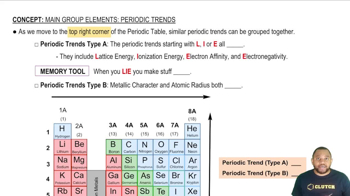
4. The progression 2, 8, 18, 32 in the number of elements in successive periods of the periodic table corresponds to the maximum number of electrons that can be accommodated in the subshells of each energy level. The first period has one energy level (1s) that can hold 2 electrons. The second period has two energy levels (2s and 2p) that can hold 2 + 6 = 8 electrons. The third period has three energy levels (3s, 3p, and 3d) that can hold 2 + 6 + 10 = 18 electrons. The fourth period has four energy levels (4s, 4p, 4d, and 4f) that can hold 2 + 6 + 10 + 14 = 32 electrons.
5. Therefore, the number of elements in each period of the periodic table increases by the progression 2, 8, 18, 32 because this reflects the increasing capacity of the atomic orbitals to hold electrons as we move down the periods.
비슷한 문제에 대한 검증된 영상 답변:
이 영상 해법은 위 문제에 도움이 된다고 튜터들이 추천한 것입니다.
영상 길이:
2m
영상 재생:
0 댓글
주요 개념
질문에 올바르게 답하기 위해 반드시 이해해야 하는 핵심 개념들은 다음과 같습니다.
Electron Shells and Energy Levels
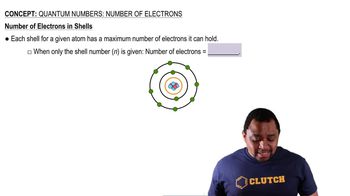
Elements in the periodic table are arranged according to their electron configurations, which are organized into shells or energy levels. Each shell can hold a specific maximum number of electrons, determined by the formula 2n², where n is the principal quantum number. This structure explains why the first shell holds 2 electrons, the second holds 8, and so forth.
Within each electron shell, there are subshells (s, p, d, f) that further define the distribution of electrons. As you move to higher energy levels, additional subshells become available, allowing for more electrons to occupy the shell. For example, the third shell includes s and p subshells (totaling 8) and the d subshell (adding 10), leading to a total of 18 electrons.
The periodic table is structured in periods (rows) and groups (columns) that reflect similar chemical properties. The increase in the number of elements in successive periods (2, 8, 18, 32) corresponds to the filling of these electron shells and subshells, which influences the chemical behavior and reactivity of the elements. This systematic arrangement helps predict element properties based on their position in the table.


 검증된 단계별 안내
 00:46
00:46