
Ch.6 - Ionic Compounds: Periodic Trends and Bonding Theory
McMurry - Chemistry 8th Edition
McMurry8th EditionChemistryISBN: 9781292336145당신이 사용하는 게 아니라요?교과서 변경
6장, 문제 144

At 0 °C, the density of liquid water is 0.9998 g/mL and the value of Kw is 1.14 * 10-15. What fraction of the molecules in liquid water are dissociated at 0 °C? What is the percent dissociation at 0 °C? What is the pH of a neutral solution at 0 °C?

검증된 단계별 안내
1
Calculate the concentration of water (in moles per liter) using its density and the molar mass of water. The molar mass of water (H2O) is approximately 18.015 g/mol. Use the formula: concentration of water = (density of water in g/mL) * (1000 mL/L) / (molar mass of water in g/mol).
Use the value of Kw to find the concentration of hydrogen ions [H+] and hydroxide ions [OH-] in the solution. Since Kw = [H+][OH-], and at 0 °C Kw = 1.14 * 10^-15, assume [H+] = [OH-] for a neutral solution and solve for [H+] and [OH-].
Calculate the fraction of dissociated water molecules by dividing the concentration of hydrogen ions [H+] by the initial concentration of water. Use the formula: fraction dissociated = [H+] / initial concentration of water.
Convert the fraction of dissociated molecules to percent dissociation by multiplying the fraction by 100.
Determine the pH of the solution using the concentration of hydrogen ions [H+]. pH is defined as the negative logarithm (base 10) of the hydrogen ion concentration. Use the formula: pH = -log10([H+]).

비슷한 문제에 대한 검증된 영상 답변:

이 영상 해법은 위 문제에 도움이 된다고 튜터들이 추천한 것입니다.
영상 길이:
7m

주요 개념

질문에 올바르게 답하기 위해 반드시 이해해야 하는 핵심 개념들은 다음과 같습니다.

Dissociation of Water

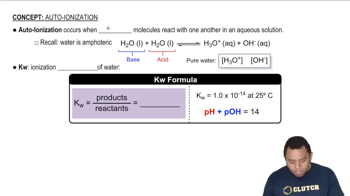
Water undergoes a self-ionization process where a small fraction of water molecules dissociate into hydrogen ions (H⁺) and hydroxide ions (OH⁻). This equilibrium is represented by the equation: 2 H₂O ⇌ H₃O⁺ + OH⁻. The equilibrium constant for this reaction at a given temperature is denoted as Kw, which reflects the product of the concentrations of the ions produced.
추천 영상:
가이드 코스
04:52
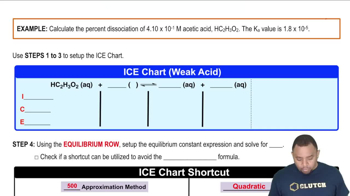
Percent Dissociation Example

Kw and pH Relationship

Kw, the ion product of water, is defined as the product of the concentrations of H⁺ and OH⁻ ions in water. At 0 °C, Kw is given as 1.14 × 10⁻¹⁵. The pH of a solution is calculated using the formula pH = -log[H⁺]. In pure water, the concentrations of H⁺ and OH⁻ are equal, allowing us to determine the pH based on the value of Kw.
추천 영상:
가이드 코스
02:22
Auto-Ionization and Kw

Percent Dissociation

Percent dissociation refers to the fraction of the total number of molecules that have dissociated into ions. It can be calculated using the formula: (number of dissociated molecules / total number of molecules) × 100%. To find this value for water at 0 °C, one must first determine the concentration of dissociated ions from Kw and relate it to the total concentration of water.
추천 영상:
가이드 코스
04:52
Percent Dissociation Example