Ch.9 - Thermochemistry: Chemical Energy
McMurry - Chemistry 8th Edition
McMurry8th EditionChemistryISBN: 9781292336145당신이 사용하는 게 아니라요?교과서 변경
9장, 문제 47

Assume that the kinetic energy of a 1400-kg car moving at 115 km/h (Problem 9.46) could be converted entirely into heat. What amount of water could be heated from 20 °C to 50 °C by the car's energy? 4.184 J are required to heat 1 g of water by 1 °C.

검증된 단계별 안내
1
Convert the speed of the car from km/h to m/s by multiplying by \(\frac{1000 \text{ m}}{1 \text{ km}}\) and dividing by \(\frac{3600 \text{ s}}{1 \text{ h}}\).
Calculate the kinetic energy (KE) of the car using the formula \(KE = \frac{1}{2} m v^2\), where \(m\) is the mass of the car and \(v\) is its velocity in m/s.
Determine the total amount of heat energy required to raise the temperature of water from 20 °C to 50 °C using the formula \(Q = mc\Delta T\), where \(m\) is the mass of the water in grams, \(c\) is the specific heat capacity of water (4.184 J/g°C), and \(\Delta T\) is the change in temperature.
Set the kinetic energy calculated in step 2 equal to the heat energy calculated in step 3 to find the mass of water that can be heated, solving for \(m\).
Convert the mass of water from grams to kilograms if necessary by dividing by 1000.

비슷한 문제에 대한 검증된 영상 답변:

이 영상 해법은 위 문제에 도움이 된다고 튜터들이 추천한 것입니다.
영상 길이:
4m

주요 개념

질문에 올바르게 답하기 위해 반드시 이해해야 하는 핵심 개념들은 다음과 같습니다.

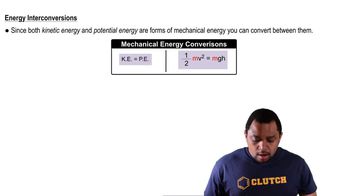
Kinetic Energy

Kinetic energy is the energy an object possesses due to its motion, calculated using the formula KE = 0.5 * m * v², where m is mass and v is velocity. In this scenario, the car's mass and speed are used to determine the total kinetic energy, which is then converted into heat energy.
추천 영상:
가이드 코스
00:34
Kinetic & Potential Energy

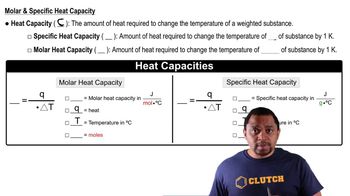
Heat Transfer and Specific Heat Capacity

Heat transfer refers to the movement of thermal energy from one object to another, while specific heat capacity is the amount of heat required to raise the temperature of a unit mass of a substance by one degree Celsius. For water, this value is 4.184 J/g°C, indicating how much energy is needed to heat water, which is crucial for calculating how much water can be heated by the car's energy.
추천 영상:

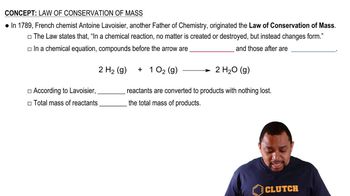
Energy Conservation

The principle of energy conservation states that energy cannot be created or destroyed, only transformed from one form to another. In this problem, the kinetic energy of the car is entirely converted into thermal energy, which is then used to heat water, illustrating the transformation of energy types while adhering to conservation laws.
추천 영상:
가이드 코스
01:48
Law of Conservation of Mass