
Ch.9 - Thermochemistry: Chemical Energy
McMurry - Chemistry 8th Edition
McMurry8th EditionChemistryISBN: 9781292336145당신이 사용하는 게 아니라요?교과서 변경
9장, 문제 7

How much heat is required to raise a 50.0 g piece of iron from 25 °C to its melting point of 1538 °C? The specific heat capacity for iron is 0.451 J/g•°C. (a) 34.1 kJ (b) 168 kJ (c) 12.1 kJ (d) 6.78 kJ

검증된 단계별 안내
1
Identify the given values: mass of iron (m) = 50.0 g, initial temperature (T_initial) = 25 °C, final temperature (T_final) = 1538 °C, and specific heat capacity of iron (c) = 0.451 J/g•°C.
Understand the formula for heat transfer, which is Q = m * c * ΔT, where Q is the heat required, m is the mass, c is the specific heat capacity, and ΔT is the change in temperature.
Calculate the change in temperature (ΔT) by subtracting the initial temperature from the final temperature: ΔT = T_final - T_initial.
Substitute the values into the heat transfer formula: Q = 50.0 g * 0.451 J/g•°C * (1538 °C - 25 °C).
Convert the result from joules to kilojoules by dividing by 1000, as 1 kJ = 1000 J.

비슷한 문제에 대한 검증된 영상 답변:

이 영상 해법은 위 문제에 도움이 된다고 튜터들이 추천한 것입니다.
영상 길이:
2m

주요 개념

질문에 올바르게 답하기 위해 반드시 이해해야 하는 핵심 개념들은 다음과 같습니다.

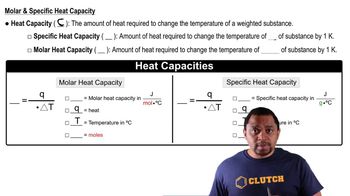
Specific Heat Capacity

Specific heat capacity is the amount of heat required to raise the temperature of one gram of a substance by one degree Celsius. It is a material-specific property that indicates how much energy is needed to change the temperature of a substance, which is crucial for calculating heat transfer in thermal processes.
추천 영상:

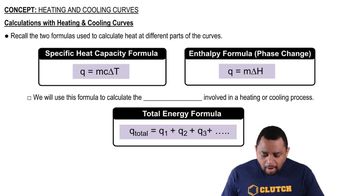
Heat Transfer Calculation

The heat transfer (q) required to change the temperature of a substance can be calculated using the formula q = m × c × ΔT, where m is the mass, c is the specific heat capacity, and ΔT is the change in temperature. This formula allows us to quantify the energy needed for temperature changes in various materials.
추천 영상:
가이드 코스
01:05
Calculations with Heating and Cooling Curves

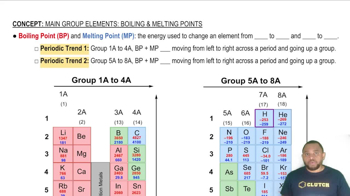
Phase Change and Melting Point

The melting point is the temperature at which a solid becomes a liquid. In this context, understanding the melting point of iron (1538 °C) is essential, as it indicates the temperature to which the iron must be heated. The energy required to reach this temperature from an initial state is calculated using the specific heat capacity.
추천 영상:
가이드 코스
04:29
Boiling Point and Melting Point
관련 실천
교과서 질문

Several processes are given in the table and labeled as endo- thermic or exothermic and given a sign for ∆H°. Which process is labeled with the correct sign of ∆H° and correct classification as endothermic or exothermic? (LO 9.8) Process (c) Water freezes into ice in the freezer.

288
views
교과서 질문

Several processes are given in the table and labeled as endo- thermic or exothermic and given a sign for ∆H°. Which process is labeled with the correct sign of ∆H° and correct classification as endothermic or exothermic? (LO 9.8) Process (d) Rubbing alcohol evaporates from your skin.

263
views
교과서 질문

Several processes are given in the table and labeled as endo- thermic or exothermic and given a sign for ∆H°. Which process is labeled with the correct sign of ∆H° and correct classification as endothermic or exothermic? (LO 9.8) Process (b) Methane, the main component of natural gas, is burned to produce a flame on a stovetop.

273
views
교과서 질문
Calculate the enthalpy change for the reaction C(s) + 2 H2(g) → CH4(g) ΔH = ? Given the enthalpy values for the following reactions CH4(g) + 2 O2(g) → CO2(g) + 2 H2O(l) ΔH = −890.4 kJ C(s) + O2(g) → CO2(g) ΔH = −393.5 kJ H2(g) + 1/2 O2(g) → H2O (g) ΔH = −285.8 kJ (a) −1569.7 kJ (b) +211.1 kJ (c) −1855.5 kJ (d) −74.7 kJ
4125
views
교과서 질문
A 25.0 g piece of granite at 100.0°C was added to 100.0 g of water of 25.0°C, and the temperature rose to 28.4°C. What is the specific heat capacity of the granite? (The specific heat capacity for water is 4.18 J/(g•°C).) (LO 9.10) (a) 0.563 J/(g•°C) (b) 1.53 J/(g•°C) (c) 0.992 J/(g•°C) (d) 0.794 J/(g•°C)
1328
views
교과서 질문

When 12.5 g of NH4NO3 is dissolved in 150.0 g of water of 25.0 °C in a coffee cup calorimeter, the final temperature of the solution of 19.7 °C. Assume that the specific heat of the solution is the same as that of water, 4.18 J/(g•°C). What is the ΔH per mol of NH4NO3? (LO 9.10) NH4NO3 (s) → NH4+ (aq) + NO3−(aq) ΔH = ? (a) +3.60 kJ (b) +23.0 kJ (c) +21.3 kJ (d) −3.60 kJ

2942
views