Ch.9 - Thermochemistry: Chemical Energy
McMurry - Chemistry 8th Edition
McMurry8th EditionChemistryISBN: 9781292336145당신이 사용하는 게 아니라요?교과서 변경
9장, 문제 151b

Phosgene, COCl2(g), is a toxic gas used as an agent of warfare in World War I. (b) Using the table of bond dissociation energies (Table 9.3) and the value ΔH°f = 716.7 kJ/mol for C(g), estimate ΔH°f for COCl2(g) at 25 °C. Compare your answer to the actual ΔH°f given in Appendix B, and explain why your calculation is only an estimate.

검증된 단계별 안내
1
Identify the bonds present in COCl_2(g): one C=O bond and two C-Cl bonds.
Use the table of bond dissociation energies to find the energy required to break each bond: C=O and C-Cl.
Calculate the total energy required to break all bonds in COCl_2(g) to form gaseous atoms: C(g), O(g), and Cl(g).
Use the given ΔH°_f for C(g) and the bond dissociation energies to estimate the enthalpy change for the formation of COCl_2(g) from its elements in their standard states.
Compare the estimated ΔH°_f with the actual value from Appendix B and discuss the limitations of using bond dissociation energies, such as neglecting the effects of molecular environment and phase changes.

비슷한 문제에 대한 검증된 영상 답변:

이 영상 해법은 위 문제에 도움이 된다고 튜터들이 추천한 것입니다.
영상 길이:
9m

주요 개념

질문에 올바르게 답하기 위해 반드시 이해해야 하는 핵심 개념들은 다음과 같습니다.

Bond Dissociation Energy

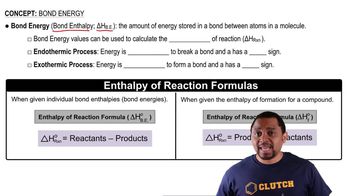
Bond dissociation energy is the energy required to break a bond in a molecule, resulting in the formation of separate atoms or radicals. It is a crucial concept in thermochemistry as it helps estimate the enthalpy changes during chemical reactions. By using bond dissociation energies, one can calculate the overall energy change when bonds are broken and formed, which is essential for determining the standard enthalpy of formation (ΔH°f) of a compound.
추천 영상:

Standard Enthalpy of Formation (ΔH°f)

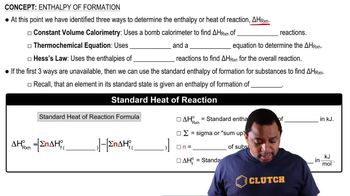
The standard enthalpy of formation (ΔH°f) is defined as the change in enthalpy when one mole of a compound is formed from its elements in their standard states. This value is critical for understanding the energy changes associated with chemical reactions. In the context of phosgene, estimating ΔH°f involves considering the enthalpy changes from the formation of carbon, oxygen, and chlorine to the formation of COCl2.
추천 영상:
가이드 코스
02:34
Enthalpy of Formation

Estimation vs. Actual Values

When calculating thermodynamic values like ΔH°f, estimates are often based on average bond dissociation energies, which can vary due to molecular environment and interactions. This means that the calculated value may not match the actual ΔH°f found in tables, as the latter is determined experimentally under specific conditions. Discrepancies arise from factors such as molecular geometry, resonance, and the presence of other interactions that are not accounted for in simple bond energy calculations.
추천 영상:
가이드 코스
03:05
Ksp vs Q in Precipitation
관련 실천
교과서 질문

Acid spills are often neutralized with sodium carbonate or sodium hydrogen carbonate. For neutralization of acetic acid, the unbalanced equations are

(1) CH3CO2H(l) + Na2CO3(s) → CH3CO2Na(aq) + CO2(g) + H2O(l)

(2) CH3CO2H(l) + NaHCO3(s) → CH3CO2Na(aq) + CO2(g) + H2O(l)

(a) Balance both equations.

689
views
교과서 질문

Acid spills are often neutralized with sodium carbonate or sodium hydrogen carbonate. For neutralization of acetic acid, the unbalanced equations are

(1) CH3CO2H(l) + Na2CO3(s) → CH3CO2Na(aq) + CO2(g) + H2O(l)

(2) CH3CO2H(l) + NaHCO3(s) → CH3CO2Na(aq) + CO2(g) + H2O(l)

(b) How many kilograms of each substance is needed to neutralize a 1.000-gallon spill of pure acetic acid (density = 1.049 g/mL)?

1508
views
교과서 질문
9.149 Consider the reaction: 4 CO1g2 2 NO21g2 4 CO21g2 N21g2. Using the following information, determine ΔH° for the reaction at 25 °C. NO1g2 ΔH°f = + 91.3 kJ>mol CO21g2 ΔH°f = - 393.5 kJ>mol 2 NO1g2 + O21g2 S 2 NO21g2 ΔH° = - 116.2 kJ 2 CO1g2 + O21g2 S 2 CO21g2 ΔH° = - 566.0 kJ
408
views
교과서 질문
Combustion analysis of 0.1500 g of methyl tert-butyl ether, an octane booster used in gasoline, gave 0.3744 g of CO2 and 0.1838 g of H2O. When a flask having a volume of 1.00 L was evacuated and then filled with methyl tertbutyl ether vapor at a pressure of 100.0 kPa and a temperature of 54.8 °C, the mass of the flask increased by 3.233 g. (d) The enthalpy of combustion for methyl tert-butyl ether is ΔH° combustion = -3368.7 kJ>mol. What is its standard enthalpy of enthalpy of formation, ΔH°f?
396
views
교과서 질문
Imagine that you dissolve 10.0 g of a mixture of NaNO3 and KF in 100.0 g of water and find that the temperature rises by 2.22 °C. Using the following data, calculate the mass of each compound in the original mixture. Assume that the specific heat of the solution is 4.18 J>1 g °C2 NaNO31s2 S NaNO31aq2 ΔH = + 20.4 kJ>mol KF1s2 S KF1aq2 ΔH = - 17.7 kJ>mol
792
views
교과서 질문
Acid spills are often neutralized with sodium carbonate or sodium hydrogen carbonate. For neutralization of acetic acid, the unbalanced equations are 112 CH3CO2H1l2 + Na2CO31s2 S CH3CO2Na1aq2 + CO21g2 + H2O1l2 122 CH3CO2H1l2 + NaHCO31s2 CH3CO2Na1aq2 + CO21g2 + H2O1l2 (c) How much heat in kilojoules is absorbed or liberated in each reaction? See Appendix B for standard heats of for- mation; ΔH°f = - 726.1 kJ>mol for CH3CO2 Na(aq).
645
views