Ch.9 - Thermochemistry: Chemical Energy
McMurry - Chemistry 8th Edition
McMurry8th EditionChemistryISBN: 9781292336145당신이 사용하는 게 아니라요?교과서 변경
9장, 문제 145

We said in Section 9.1 that the potential energy of water at the top of a dam or waterfall is converted into heat when the water dashes against rocks at the bottom. The potential energy of the water at the top is equal to EP = mgh, where m is the mass of the water, g is the acceleration of the falling water due to gravity 1g = 9.81 m>s22, and h is the height of the water. Assuming that all the energy is converted to heat, calculate the temperature rise of the water in degrees Celsius after falling over California's Yosemite Falls, a distance of 739 m. The specific heat of water is 4.18 J/(g·K).

검증된 단계별 안내
1
First, calculate the potential energy of the water using the formula EP = mgh. Here, m is the mass of the water, g is the acceleration due to gravity (9.81 m/s^2), and h is the height of the waterfall (739 m).
Next, convert the potential energy into heat energy. Since the problem assumes that all the potential energy is converted into heat, the heat energy is equal to the potential energy.
Then, use the formula for heat transfer q = mcΔT to calculate the temperature change ΔT. Here, q is the heat energy, m is the mass of the water, c is the specific heat of water (4.18 J/(g·K)), and ΔT is the temperature change.
Rearrange the formula to solve for ΔT: ΔT = q / (mc). Substitute the values for q, m, and c into the formula.
Finally, note that the temperature change will be in Kelvin. To convert it to degrees Celsius, remember that a change of 1 K is equivalent to a change of 1°C. Therefore, the temperature change in degrees Celsius is the same as in Kelvin.

비슷한 문제에 대한 검증된 영상 답변:

이 영상 해법은 위 문제에 도움이 된다고 튜터들이 추천한 것입니다.
영상 길이:
3m

주요 개념

질문에 올바르게 답하기 위해 반드시 이해해야 하는 핵심 개념들은 다음과 같습니다.

Potential Energy

Potential energy is the energy stored in an object due to its position in a gravitational field. In the context of water at the top of a dam, it is calculated using the formula EP = mgh, where m is mass, g is the acceleration due to gravity, and h is the height. This energy is converted into kinetic energy as the water falls, and ultimately into heat energy upon impact.
추천 영상:
가이드 코스
00:34
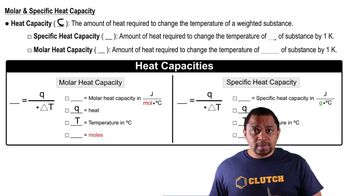
Kinetic & Potential Energy

Specific Heat Capacity

Specific heat capacity is the amount of heat required to raise the temperature of a unit mass of a substance by one degree Celsius (or Kelvin). For water, this value is 4.18 J/(g·K), indicating that it takes 4.18 joules of energy to raise the temperature of one gram of water by one degree. This concept is crucial for calculating the temperature change of water after it has converted potential energy into heat.
추천 영상:

Energy Conservation

The principle of energy conservation states that energy cannot be created or destroyed, only transformed from one form to another. In this scenario, the potential energy of the falling water is transformed into thermal energy (heat) upon impact. Understanding this principle allows us to calculate the resulting temperature increase of the water after it falls, as all potential energy is assumed to convert into heat energy.
추천 영상:
가이드 코스
01:48
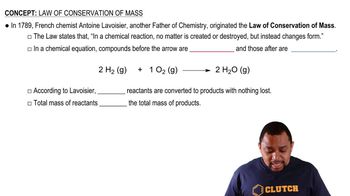
Law of Conservation of Mass
관련 실천
교과서 질문
Given 400.0 g of hot tea at 80.0 °C, what mass of ice at 0 °C must be added to obtain iced tea at 10.0 °C? The specific heat of the tea is 4.18 J>1g °C2 and ΔHfusion for ice is + 6.01 kJ>mol.
1829
views
교과서 질문

Methanol (CH3OH) is made industrially in two steps from CO and H2. It is so cheap to make that it is being considered for use as a precursor to hydrocarbon fuels, such as methane (CH4):

Step 1. CO(g) + 2 H2(g) → CH3OH(l) ΔS° = –332 J/K

Step 2. CH3OH(l) → CH4(g) + 1/2 O2(g) ΔS° = 162 J/K

(f) Calculate ΔH° for step 2.

369
views
교과서 질문
Imagine that you dissolve 10.0 g of a mixture of NaNO3 and KF in 100.0 g of water and find that the temperature rises by 2.22 °C. Using the following data, calculate the mass of each compound in the original mixture. Assume that the specific heat of the solution is 4.18 J>1 g °C2 NaNO31s2 S NaNO31aq2 ΔH = + 20.4 kJ>mol KF1s2 S KF1aq2 ΔH = - 17.7 kJ>mol
792
views
교과서 질문
Ethyl chloride 1C2H5Cl2, a substance used as a topical anes-thetic, is prepared by reaction of ethylene with hydrogen chloride: C2H41g2 + HCl1g2 ¡ C2H5Cl1g2 ΔH° = - 72.3 kJ How much PV work is done in kilojoules, and what is the value of ΔE in kilojoules if 89.5 g of ethylene and 125 g of HCl are allowed to react at atmospheric pressure and the volume change is - 71.5 L?
904
views
교과서 질문
When a gaseous compound X containing only C, H, and O is burned in O2, 1 volume of the unknown gas reacts with 3 volumes of O2 to give 2 volumes of CO2 and 3 volumes of gaseous H2O. Assume all volumes are measured at the same temperature and pressure. (d) Combustion of 5.000 g of X releases 144.2 kJ heat. Look up ΔH°f values for CO21g2 and H2O1g2 in Appendix B, and calculate ΔH°f for compound X.
498
views
교과서 질문

Methanol (CH3OH) is made industrially in two steps from CO and H2. It is so cheap to make that it is being considered for use as a precursor to hydrocarbon fuels, such as methane (CH4):

Step 1. CO(g) + 2 H2(g) S CH3OH(l) ΔS° = - 332 J/K

Step 2. CH3OH(l) → CH4(g) + 1/2 O2(g) ΔS° = 162 J/K

(e) In what temperature range is step 1 spontaneous?

391
views