What is the enthalpy change (ΔH) for a reaction at a constant pressure of 1.00 atm fi the internal energy chagne (ΔE) is 44.0 kJ and the volume increase is 14.0 L? (1 L-atm = 101.325 J)
검증된 단계별 안내
1
Identify the relationship between enthalpy change (\( \Delta H \)) and internal energy change (\( \Delta E \)) using the formula: \( \Delta H = \Delta E + P\Delta V \).
Convert the volume change from liters to joules using the conversion factor: \( 1 \text{ L-atm} = 101.325 \text{ J} \). Calculate \( P\Delta V \) in joules.
Substitute the given values into the formula: \( \Delta H = 44.0 \text{ kJ} + (1.00 \text{ atm} \times 14.0 \text{ L} \times 101.325 \text{ J/L-atm}) \).
Convert the \( \Delta E \) from kilojoules to joules if necessary, to ensure consistent units when adding to \( P\Delta V \).
Add the calculated \( P\Delta V \) to \( \Delta E \) to find the enthalpy change \( \Delta H \) in joules, and convert back to kilojoules if needed.
비슷한 문제에 대한 검증된 영상 답변:
이 영상 해법은 위 문제에 도움이 된다고 튜터들이 추천한 것입니다.
영상 길이:
2m
영상 재생:
0 댓글
주요 개념
질문에 올바르게 답하기 위해 반드시 이해해야 하는 핵심 개념들은 다음과 같습니다.
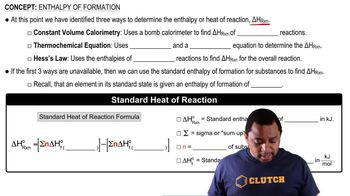
Enthalpy (ΔH)
Enthalpy is a thermodynamic quantity that represents the total heat content of a system at constant pressure. It is defined as the sum of the internal energy of the system and the product of its pressure and volume (ΔH = ΔE + PΔV). Enthalpy changes are crucial for understanding heat transfer in chemical reactions, especially when they occur at constant pressure.
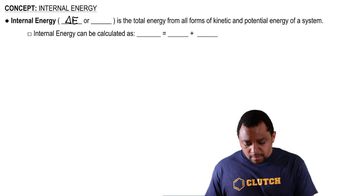
Internal energy is the total energy contained within a system, including kinetic and potential energies of the particles. The change in internal energy (ΔE) during a reaction reflects the energy absorbed or released. It is a key component in calculating enthalpy changes, as it provides the baseline energy state of the system before any work or heat transfer occurs.
In thermodynamics, work done by a system during a volume change at constant pressure is given by the product of pressure and the change in volume (PΔV). This term accounts for the energy required to expand or compress the system against external pressure. Understanding this concept is essential for calculating the total enthalpy change when a reaction involves a change in volume.