Ch.14 - Chemical Kinetics
Tro - Chemistry: A Molecular Approach 4th Edition
Tro4th EditionChemistry: A Molecular ApproachISBN: 9780134112831당신이 사용하는 게 아니라요?교과서 변경
14장, 문제 98

What fraction of the film is left after 10 s, assuming the same initial coverage as in part a, given that the evaporation of a 120-nm film of n-pentane from a single crystal of aluminum oxide is zero order with a rate constant of 1.92 * 10^13 molecules/cm^2 * s at 120 K?

검증된 단계별 안내
1
Identify that the problem involves zero-order kinetics, where the rate of reaction is constant and does not depend on the concentration of the reactant.
Use the zero-order rate equation: \[ [A] = [A]_0 - kt \] where \([A]\) is the concentration at time \(t\), \([A]_0\) is the initial concentration, \(k\) is the rate constant, and \(t\) is the time.
Determine the initial concentration \([A]_0\) in terms of molecules/cm². Since the problem states the initial coverage is the same as in part a, use that initial concentration value.
Substitute the given rate constant \(k = 1.92 \times 10^{13}\) molecules/cm²·s and the time \(t = 10\) s into the zero-order rate equation.
Calculate the concentration \([A]\) at \(t = 10\) s and then find the fraction of the film remaining by dividing \([A]\) by \([A]_0\).

주요 개념

질문에 올바르게 답하기 위해 반드시 이해해야 하는 핵심 개념들은 다음과 같습니다.

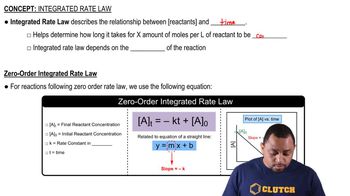
Zero-Order Kinetics

Zero-order kinetics refers to a reaction rate that is independent of the concentration of the reactant. In this case, the rate of evaporation of the n-pentane film remains constant over time, meaning that the amount of film evaporated per unit time does not change as the film thickness decreases. This concept is crucial for calculating the remaining fraction of the film after a specific time.
추천 영상:
가이드 코스
02:44
Zero-Order Reactions

Rate Constant

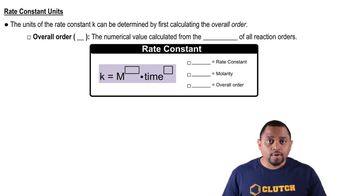
The rate constant is a proportionality factor in the rate equation that quantifies the speed of a chemical reaction. For zero-order reactions, the rate constant (in this case, 1.92 * 10^13 molecules/cm^2 * s) indicates how many molecules evaporate per square centimeter per second, providing a basis for determining how much of the film will remain after a given time period.
추천 영상:
가이드 코스
00:45
Rate Constant Units

Fraction Remaining

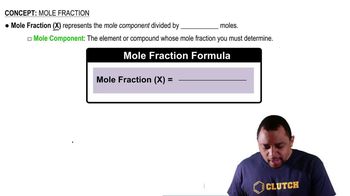
The fraction remaining of a substance after a certain time can be calculated using the initial amount and the amount that has evaporated. In this scenario, knowing the rate of evaporation and the time elapsed allows for the calculation of how much of the 120-nm film of n-pentane is left after 10 seconds, which is essential for answering the question.
추천 영상:
가이드 코스
00:36
Mole Fraction Formula
관련 실천
교과서 질문

The desorption (leaving of the surface) of a single molecular layer of n-butane from a single crystal of aluminum oxide is found to be first order with a rate constant of 0.128/s at 150 K. b. If the surface is initially completely covered with n-butane at 150 K, how long will it take for 25% of the molecules to desorb (leave the surface)? For 50% to desorb?

654
views
교과서 질문

The kinetics of this reaction were studied as a function of temperature. (The reaction is first order in each reactant and second order overall.)

C2H5Br(aq) + OH- (aq) → C2H5OH(l) + Br- (aq)

Temperature (°C) k (L,mol •s)

25 8.81⨉10-5

35 0.000285

45 0.000854

55 0.00239

65 0.00633

a. Determine the activation energy and frequency factor for the reaction.

교과서 질문

The kinetics of this reaction were studied as a function of temperature. (The reaction is first order in each reactant and second order overall.)

C2H5Br(aq) + OH- (aq) → C2H5OH(l) + Br- (aq)

Temperature (°C) k (L,mol •s)

25 8.81⨉10-5

35 0.000285

45 0.000854

55 0.00239

65 0.00633

b. Determine the rate constant at 15 °C.

1072
views
교과서 질문

The evaporation of a 120-nm film of n-pentane from a single crystal of aluminum oxide is zero order with a rate constant of 1.92⨉1013 molecules/cm2•s at 120 K. a. If the initial surface coverage is 8.9⨉1016 molecules/cm2, how long will it take for one-half of the film to evaporate?

881
views
1
rank
교과서 질문

The desorption (leaving of the surface) of a single molecular layer of n-butane from a single crystal of aluminum oxide is found to be first order with a rate constant of 0.128/s at 150 K. a. What is the half-life of the desorption reaction?-

873
views