
교과서 질문
The diagram shows the energy of a reaction as the reaction progresses. Label each blank box in the diagram.
a. reactants b. products c. activation energy (Ea) d. enthalpy of reaction (ΔHrxn)
2043
views

 검증된 단계별 안내
 02:17
02:17
 03:00
03:00 03:01
03:01The diagram shows the energy of a reaction as the reaction progresses. Label each blank box in the diagram.
a. reactants b. products c. activation energy (Ea) d. enthalpy of reaction (ΔHrxn)
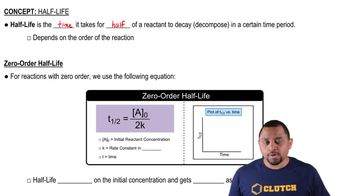
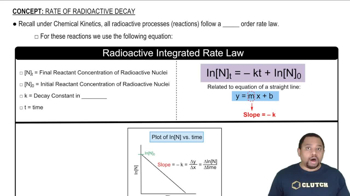
The half-life for the radioactive decay of C-14 is 5730 years and is independent of the initial concentration. If a sample of C-14 initially contains 1.5 mmol of C-14, how many millimoles are left after 2255 years?
The half-life for the radioactive decay of U-238 is 4.5 billion years and is independent of initial concentration. How long will it take for 10% of the U-238 atoms in a sample of U-238 to decay?
The activation energy of a reaction is 56.8 kJ/mol and the frequency factor is 1.5⨉1011/ s. Calculate the rate constant of the reaction at 25 °C.
The half-life for the radioactive decay of U-238 is 4.5 billion years and is independent of initial concentration. If a sample of U-238 initially contained 1.5⨉1018 atoms when the universe was formed 13.8 billion years ago, how many U-238 atoms does it contain today?
The decomposition of XY is second order in XY and has a rate constant of 7.02⨉10-3 M-1• s-1 at a certain temperature. a. What is the half-life for this reaction at an initial concentration of 0.100 M?