
Ch.14 - Chemical Kinetics
Tro - Chemistry: A Molecular Approach 4th Edition
Tro4th EditionChemistry: A Molecular ApproachISBN: 9780134112831당신이 사용하는 게 아니라요?교과서 변경
14장, 문제 100

The reaction 2 N2O5 → 2 N2O4 + O2 takes place at around room temperature in solvents such as CCl4. The rate constant at 293 K is found to be 2.35⨉10-4 s-1, and at 303 K the rate constant is found to be 9.15⨉10-4 s-1. Calculate the frequency factor for the reaction.

검증된 단계별 안내
1
Identify that the problem involves calculating the frequency factor (A) using the Arrhenius equation: k = A * e^(-Ea/(RT)), where k is the rate constant, Ea is the activation energy, R is the gas constant, and T is the temperature in Kelvin.
Use the Arrhenius equation in its logarithmic form: ln(k2/k1) = -(Ea/R) * (1/T2 - 1/T1), where k1 and k2 are the rate constants at temperatures T1 and T2, respectively.
Substitute the given values into the logarithmic form of the Arrhenius equation: ln(9.15⨉10^-4 / 2.35⨉10^-4) = -(Ea/R) * (1/303 - 1/293).
Solve for the activation energy (Ea) using the rearranged equation: Ea = -R * ln(k2/k1) / (1/T2 - 1/T1).
Once Ea is determined, use the Arrhenius equation k = A * e^(-Ea/(RT)) to solve for the frequency factor (A) by rearranging it to A = k / e^(-Ea/(RT)) and substituting the known values.

비슷한 문제에 대한 검증된 영상 답변:

이 영상 해법은 위 문제에 도움이 된다고 튜터들이 추천한 것입니다.
영상 길이:
7m

주요 개념

질문에 올바르게 답하기 위해 반드시 이해해야 하는 핵심 개념들은 다음과 같습니다.

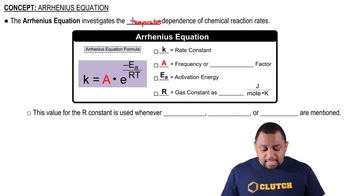
Arrhenius Equation

The Arrhenius equation relates the rate constant of a reaction to temperature and activation energy. It is expressed as k = A * e^(-Ea/RT), where k is the rate constant, A is the frequency factor, Ea is the activation energy, R is the universal gas constant, and T is the temperature in Kelvin. Understanding this equation is crucial for calculating the frequency factor, as it provides the relationship between temperature and reaction rates.
추천 영상:
가이드 코스
01:20
Arrhenius Equation

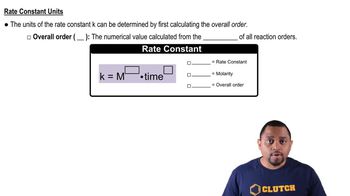
Rate Constant

The rate constant (k) is a proportionality factor in the rate law of a chemical reaction, indicating the speed of the reaction at a given temperature. It varies with temperature and is influenced by factors such as the nature of the reactants and the presence of catalysts. In this question, the rate constants at two different temperatures are provided, which are essential for determining the frequency factor using the Arrhenius equation.
추천 영상:
가이드 코스
00:45
Rate Constant Units

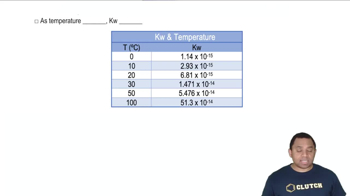
Temperature Dependence of Reaction Rates

The temperature dependence of reaction rates is a fundamental concept in chemical kinetics, indicating that reaction rates generally increase with temperature. This is due to the increased kinetic energy of molecules, leading to more frequent and effective collisions. In the context of the question, the provided rate constants at different temperatures allow for the analysis of how temperature affects the reaction rate, which is key to calculating the frequency factor.
추천 영상:
가이드 코스
01:24
Kw Temperature Dependence
관련 실천
교과서 질문

The kinetics of this reaction were studied as a function of temperature. (The reaction is first order in each reactant and second order overall.)

C2H5Br(aq) + OH- (aq) → C2H5OH(l) + Br- (aq)

Temperature (°C) k (L,mol •s)

25 8.81⨉10-5

35 0.000285

45 0.000854

55 0.00239

65 0.00633

a. Determine the activation energy and frequency factor for the reaction.

교과서 질문

The kinetics of this reaction were studied as a function of temperature. (The reaction is first order in each reactant and second order overall.)

C2H5Br(aq) + OH- (aq) → C2H5OH(l) + Br- (aq)

Temperature (°C) k (L,mol •s)

25 8.81⨉10-5

35 0.000285

45 0.000854

55 0.00239

65 0.00633

b. Determine the rate constant at 15 °C.

1072
views
교과서 질문

The kinetics of this reaction were studied as a function of temperature. (The reaction is first order in each reactant and second order overall.)

C2H5Br(aq) + OH- (aq) → C2H5OH(l) + Br- (aq)

Temperature (°C) k (L,mol •s)

25 8.81⨉10-5

35 0.000285

45 0.000854

55 0.00239

65 0.00633

c. If a reaction mixture is 0.155 M in C2H5Brand 0.250 M in OH-, what is the initial rate of the reaction at 75 °C?

교과서 질문

Consider the two reactions:

O + N2 → NO + N Ea = 315 kJ/mol

Cl + H2 → HCl + H Ea = 23 kJ/mol

a. Why is the activation barrier for the first reaction so much higher than that for the second?

561
views
교과서 질문

This reaction has an activation energy of zero in the gas phase: CH3 + CH3 → C2H6 a. Would you expect the rate of this reaction to change very much with temperature?

670
views