Ch.15 - Chemical Equilibrium
Tro - Chemistry: A Molecular Approach 4th Edition
Tro4th EditionChemistry: A Molecular ApproachISBN: 9780134112831당신이 사용하는 게 아니라요?교과서 변경
15장, 문제 32b,c

Calculate Kp for each reaction.
b. N2(g) + 3 H2(g) ⇌ 2 NH3(g) Kc = 3.7⨉108 (at 298 K)
c. N2(g) + O2(g) ⇌ 2 NO(g) Kc = 4.10⨉10-31 (at 298 K)

검증된 단계별 안내
1
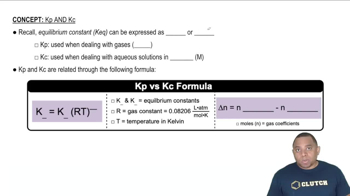
Identify the relationship between Kc and Kp using the equation: Kp = Kc(RT)^(Δn), where Δn is the change in moles of gas, R is the ideal gas constant, and T is the temperature in Kelvin.
Calculate Δn for the reaction: Δn = (moles of gaseous products) - (moles of gaseous reactants). For the reaction N2(g) + 3H2(g) ⇌ 2NH3(g), Δn = 2 - (1 + 3).
Substitute the values into the equation: Kp = Kc(RT)^(Δn). Use R = 0.0821 L·atm/(mol·K) and T = 298 K.
Simplify the expression by calculating (RT)^(Δn) using the values of R, T, and Δn.
Multiply Kc by the result from the previous step to find Kp.

비슷한 문제에 대한 검증된 영상 답변:

이 영상 해법은 위 문제에 도움이 된다고 튜터들이 추천한 것입니다.
영상 길이:
2m

주요 개념

질문에 올바르게 답하기 위해 반드시 이해해야 하는 핵심 개념들은 다음과 같습니다.

Equilibrium Constant (Kc and Kp)

The equilibrium constant (K) quantifies the ratio of the concentrations of products to reactants at equilibrium for a given reaction. Kc refers to concentrations in molarity, while Kp refers to partial pressures. The relationship between Kc and Kp is given by the equation Kp = Kc(RT)^(Δn), where Δn is the change in moles of gas, R is the ideal gas constant, and T is the temperature in Kelvin.
추천 영상:
가이드 코스
02:06
Kp vs. Kc Formula

Reaction Stoichiometry

Reaction stoichiometry involves the quantitative relationships between reactants and products in a chemical reaction. In the given reaction, N2(g) + 3H2(g) ⇌ 2NH3(g), the stoichiometric coefficients indicate that one mole of nitrogen reacts with three moles of hydrogen to produce two moles of ammonia. This stoichiometry is crucial for calculating changes in concentrations or pressures at equilibrium.
추천 영상:
가이드 코스
01:16
Stoichiometry Concept

Temperature Dependence of Kp

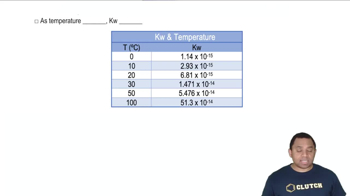
The equilibrium constant Kp is temperature-dependent, meaning its value changes with temperature. For exothermic reactions, Kp decreases with increasing temperature, while for endothermic reactions, Kp increases. Understanding this dependence is essential when calculating Kp at a specific temperature, as it directly influences the equilibrium position and the concentrations of reactants and products.
추천 영상:
가이드 코스
01:24
Kw Temperature Dependence