
Ch.15 - Chemical Equilibrium
Tro - Chemistry: A Molecular Approach 4th Edition
Tro4th EditionChemistry: A Molecular ApproachISBN: 9780134112831당신이 사용하는 게 아니라요?교과서 변경
15장, 문제 54

For the reaction shown here, Kc = 255 at 1000 K. CO(g) + Cl2(g) ⇌ COCl2(g) If a reaction mixture initially contains a CO concentration of 0.1500 M and a Cl2 concentration of 0.175 M at 1000 K, what are the equilibrium concentrations of CO, Cl2, and COCl2 at 1000 K?

검증된 단계별 안내
1
Step 1: Set up the initial concentrations of the reactants and products. For CO and Cl2, the initial concentrations are given as 0.1500 M and 0.175 M, respectively. Assume the initial concentration of COCl2 is 0 M.
Step 2: Define the change in concentration that occurs as the system reaches equilibrium. Let x be the amount of CO and Cl2 that reacts. At equilibrium, the concentration of CO and Cl2 will decrease by x, and the concentration of COCl2 will increase by x.
Step 3: Write the equilibrium expression for the reaction using the equilibrium constant Kc. The expression is Kc = \(\frac{[COCl2]}{[CO][Cl2]}\).
Step 4: Substitute the equilibrium concentrations into the Kc expression. This gives Kc = \(\frac{x}{(0.1500 - x)(0.175 - x)}\).
Step 5: Solve the equation for x using algebraic methods or a numerical solver to find the equilibrium concentrations of CO, Cl2, and COCl2.

비슷한 문제에 대한 검증된 영상 답변:

이 영상 해법은 위 문제에 도움이 된다고 튜터들이 추천한 것입니다.

주요 개념

질문에 올바르게 답하기 위해 반드시 이해해야 하는 핵심 개념들은 다음과 같습니다.

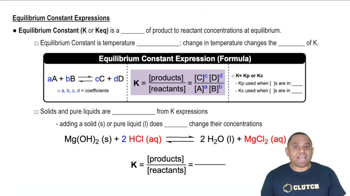
Equilibrium Constant (Kc)

The equilibrium constant, Kc, is a numerical value that expresses the ratio of the concentrations of products to reactants at equilibrium for a given reaction at a specific temperature. For the reaction CO(g) + Cl2(g) ⇌ COCl2(g), Kc = [COCl2] / ([CO][Cl2]). A higher Kc value indicates a greater concentration of products at equilibrium.
추천 영상:
가이드 코스
03:20
Equilibrium Constant Expressions

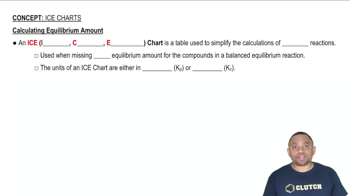
ICE Table (Initial, Change, Equilibrium)

An ICE table is a tool used to organize the initial concentrations, the changes in concentrations as the reaction proceeds, and the equilibrium concentrations of reactants and products. By setting up an ICE table for the given reaction, one can systematically determine how the concentrations of CO, Cl2, and COCl2 change until equilibrium is reached.
추천 영상:
가이드 코스
01:14
ICE Charts and Equilibrium Amount

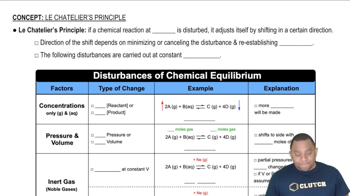
Le Chatelier's Principle

Le Chatelier's Principle states that if a dynamic equilibrium is disturbed by changing the conditions, the system will adjust to counteract the change and restore a new equilibrium. This principle helps predict how changes in concentration, pressure, or temperature will affect the position of equilibrium in the reaction CO(g) + Cl2(g) ⇌ COCl2(g).
추천 영상:
가이드 코스
07:32
Le Chatelier's Principle