


Given the values of ΔH°rxn, ΔS°rxn, and T, determine ΔSuniv and predict whether or not each reaction is spontaneous. (Assume that all reactants and products are in their standard states.) c. ΔH°rxn = -115 kJ; ΔS°rxn = -263 J/K; T = 298 K
Ch.18 - Free Energy and Thermodynamics
18장, 문제 39d
Calculate ΔSsurr at the indicated temperature for each reaction. d. ΔH°rxn = +114 kJ; 77 K
검증된 단계별 안내1
Identify the formula to calculate the change in entropy of the surroundings, which is given by \( \Delta S_{\text{surr}} = -\frac{\Delta H_{\text{rxn}}}{T} \).
Note that \( \Delta H_{\text{rxn}} \) is given as +114 kJ. Since entropy is typically expressed in J/K, convert \( \Delta H_{\text{rxn}} \) from kJ to J by multiplying by 1000.
The temperature \( T \) is given as 77 K. Ensure that the temperature is in Kelvin, which it is in this case.
Substitute the values into the formula: \( \Delta S_{\text{surr}} = -\frac{114,000 \text{ J}}{77 \text{ K}} \).
Simplify the expression to find \( \Delta S_{\text{surr}} \).

비슷한 문제에 대한 검증된 영상 답변:
이 영상 해법은 위 문제에 도움이 된다고 튜터들이 추천한 것입니다.
영상 길이:
1m주요 개념
질문에 올바르게 답하기 위해 반드시 이해해야 하는 핵심 개념들은 다음과 같습니다.
Entropy (ΔS)
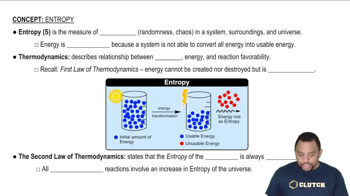
Entropy is a measure of the disorder or randomness in a system. In thermodynamics, it quantifies the amount of energy in a physical system that is not available to do work. A positive change in entropy (ΔS > 0) indicates an increase in disorder, while a negative change (ΔS < 0) suggests a decrease in disorder. Understanding entropy is crucial for predicting the spontaneity of reactions.
추천 영상:
가이드 코스
Entropy in Thermodynamics
Enthalpy (ΔH)
Enthalpy is a thermodynamic property that reflects the total heat content of a system. It is defined as the internal energy plus the product of pressure and volume (H = U + PV). The change in enthalpy (ΔH) during a reaction indicates whether the reaction is exothermic (ΔH < 0) or endothermic (ΔH > 0). This concept is essential for calculating the surrounding entropy (ΔS surr) using the relationship between enthalpy and temperature.
추천 영상:
가이드 코스
Enthalpy of Formation
Gibbs Free Energy and Surrounding Entropy
The Gibbs free energy (G) combines enthalpy and entropy to determine the spontaneity of a reaction at constant temperature and pressure. The relationship ΔG = ΔH - TΔS allows us to calculate the change in entropy of the surroundings (ΔS surr) using the enthalpy change and the temperature. A reaction is spontaneous if ΔG is negative, which is influenced by both ΔH and ΔS surr.
추천 영상:
가이드 코스
Gibbs Free Energy of Reactions
관련 실천
교과서 질문
1060
views
교과서 질문
Without doing any calculations, determine the signs of ΔSsys and ΔSsurr for each chemical reaction. In addition, predict under what temperatures (all temperatures, low temperatures, or high temperatures), if any, the reaction is spontaneous. c. 2 N2(g) + O2(g) → 2 N2O(g) ΔH°rxn = +163.2 kJ
596
views
교과서 질문
Given the values of ΔH°rxn, ΔS°rxn, and T, determine ΔSuniv and predict whether or not each reaction is spontaneous. (Assume that all reactants and products are in their standard states.) a. ΔH°rxn = +115 kJ; ΔS°rxn = -263 J/K; T = 298 K
1477
views
1
comments
