Ch.18 - Free Energy and Thermodynamics
Tro - Chemistry: A Molecular Approach 4th Edition
Tro4th EditionChemistry: A Molecular ApproachISBN: 9780134112831당신이 사용하는 게 아니라요?교과서 변경
18장, 문제 52

For each pair of substances, choose the one that you expect to have the higher standard molar entropy (S°) at 25 °C. Explain your choices. a. NaNO3(s); NaNO3(aq) b. CH4(g); CH3CH3(g) c. Br2(l); Br2(g) d. Br2(g); F2(g) e. PCl3(g); PCl5(g) f. CH3CH2CH2CH3(g); SO2(g)

검증된 단계별 안내
1
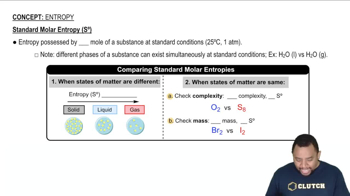
Step 1: Understand that standard molar entropy (S°) is a measure of the amount of disorder or randomness in a system. Generally, gases have higher entropy than liquids, which have higher entropy than solids. Additionally, more complex molecules or those with more atoms tend to have higher entropy.
Step 2: For part a, compare NaNO3(s) and NaNO3(aq). The aqueous solution (NaNO3(aq)) will have higher entropy than the solid (NaNO3(s)) because the ions are more dispersed in solution, increasing disorder.
Step 3: For part b, compare CH4(g) and CH3CH3(g). CH3CH3(g) is a larger molecule with more atoms than CH4(g), which generally leads to higher entropy due to increased molecular complexity and more possible microstates.
Step 4: For part c, compare Br2(l) and Br2(g). Br2(g) will have higher entropy than Br2(l) because gases have more freedom of movement and greater disorder than liquids.
Step 5: For part d, compare Br2(g) and F2(g). Although both are gases, Br2(g) is a larger molecule with more electrons than F2(g), which typically results in higher entropy due to more vibrational modes and possible microstates.

비슷한 문제에 대한 검증된 영상 답변:

이 영상 해법은 위 문제에 도움이 된다고 튜터들이 추천한 것입니다.
영상 길이:
1m

주요 개념

질문에 올바르게 답하기 위해 반드시 이해해야 하는 핵심 개념들은 다음과 같습니다.

Standard Molar Entropy (S°)

Standard molar entropy (S°) is a measure of the amount of disorder or randomness in a system at a standard state, typically 25 °C and 1 atm. It reflects the number of accessible microstates for a substance, with higher values indicating greater disorder. Entropy increases with temperature, molecular complexity, and the phase of the substance, with gases generally having higher entropies than liquids and solids.
추천 영상:
가이드 코스
03:33
Standard Molar Entropy

Phase Changes and Entropy

The phase of a substance significantly affects its entropy. Gases have higher entropy than liquids, which in turn have higher entropy than solids due to the increased freedom of movement and greater number of microstates available in gaseous states. When comparing substances in different phases, the one in the gaseous state will typically have a higher standard molar entropy than its liquid or solid counterpart.
추천 영상:
가이드 코스
01:46
Entropy in Phase Changes

Molecular Complexity and Entropy

Molecular complexity also influences entropy; larger and more complex molecules tend to have higher entropies than simpler ones. This is because complex molecules can adopt more configurations and have more vibrational modes. When comparing substances, those with more atoms or greater structural diversity will generally exhibit higher standard molar entropy values.
추천 영상:
가이드 코스
01:21
Factors Affecting Entropy