Ch.18 - Free Energy and Thermodynamics
Tro - Chemistry: A Molecular Approach 4th Edition
Tro4th EditionChemistry: A Molecular ApproachISBN: 9780134112831당신이 사용하는 게 아니라요?교과서 변경
18장, 문제 61a

For each reaction, calculate ΔH°rxn, ΔS°rxn, and ΔG°rxn at 25 °C and state whether or not the reaction is spontaneous. If the reaction is not spontaneous, would a change in temperature make it spontaneous? If so, should the temperature be raised or lowered from 25 °C? a. N2O4(g) → 2 NO2(g)

검증된 단계별 안내
1
Identify the standard enthalpy change (ΔH°) and standard entropy change (ΔS°) for the reaction using standard enthalpies and entropies of formation for each compound.
Calculate the standard enthalpy change of the reaction (ΔH°rxn) using the formula: ΔH°rxn = ΣΔH°f(products) - ΣΔH°f(reactants).
Calculate the standard entropy change of the reaction (ΔS°rxn) using the formula: ΔS°rxn = ΣS°(products) - ΣS°(reactants).
Calculate the standard Gibbs free energy change (ΔG°rxn) using the formula: ΔG°rxn = ΔH°rxn - TΔS°rxn, where T is the temperature in Kelvin (298 K for 25 °C).
Determine the spontaneity of the reaction: if ΔG°rxn < 0, the reaction is spontaneous; if ΔG°rxn > 0, the reaction is non-spontaneous. If non-spontaneous, analyze the signs of ΔH°rxn and ΔS°rxn to decide if changing the temperature could make the reaction spontaneous.

비슷한 문제에 대한 검증된 영상 답변:

이 영상 해법은 위 문제에 도움이 된다고 튜터들이 추천한 것입니다.
영상 길이:
6m

주요 개념

질문에 올바르게 답하기 위해 반드시 이해해야 하는 핵심 개념들은 다음과 같습니다.

Thermodynamic Functions (ΔH°, ΔS°, ΔG°)

ΔH° (enthalpy change), ΔS° (entropy change), and ΔG° (Gibbs free energy change) are fundamental thermodynamic functions used to assess the energy and disorder changes in a chemical reaction. ΔH° indicates whether a reaction is exothermic or endothermic, while ΔS° reflects the change in disorder. ΔG° combines these two to determine spontaneity; a negative ΔG° indicates a spontaneous reaction at a given temperature.
추천 영상:
가이드 코스
01:18
First Law of Thermodynamics

Spontaneity of Reactions

A reaction is considered spontaneous if it occurs without external intervention, which is determined by the sign of ΔG°. If ΔG° is negative, the reaction is spontaneous; if positive, it is non-spontaneous. The spontaneity can also depend on temperature, as the relationship between ΔH°, ΔS°, and ΔG° is temperature-dependent, described by the equation ΔG° = ΔH° - TΔS°.
추천 영상:
가이드 코스
04:20
Spontaneity of Processes

Temperature's Effect on Spontaneity

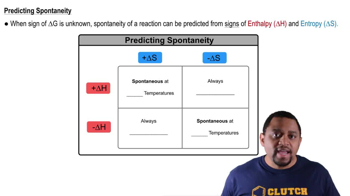
The temperature can influence the spontaneity of a reaction, particularly when ΔH° and ΔS° have opposing signs. If ΔS° is positive (increased disorder) and ΔH° is positive (endothermic), raising the temperature can make ΔG° negative, thus making the reaction spontaneous. Conversely, if ΔS° is negative (decreased disorder) and ΔH° is negative (exothermic), lowering the temperature may be necessary for spontaneity.
추천 영상:
가이드 코스
01:17
Spontaneity and Temperature