
Use standard free energies of formation to calculate ΔG° at 25 °C for each reaction in Problem 61. How do the values of ΔG° calculated this way compare to those calculated from ΔH° and ΔS°? Which of the two methods could be used to determine how ΔG° changes with temperature?
Ch.18 - Free Energy and Thermodynamics
18장, 문제 62d
For each reaction, calculate ΔH°rxn, ΔS°rxn, and ΔG°rxn at 25 °C and state whether or not the reaction is spontaneous. If the reaction is not spontaneous, would a change in temperature make it spontaneous? If so, should the temperature be raised or lowered from 25 °C? d. 2 KClO3(s) → 2 KCl(s) + 3 O2(g)
검증된 단계별 안내1
Identify the standard enthalpy change (\( \Delta H^\circ \)) for the reaction by using standard enthalpies of formation (\( \Delta H_f^\circ \)) for each compound involved. Use the formula: \( \Delta H^\circ_{\text{rxn}} = \sum \Delta H_f^\circ (\text{products}) - \sum \Delta H_f^\circ (\text{reactants}) \).
Determine the standard entropy change (\( \Delta S^\circ \)) for the reaction using standard molar entropies (\( S^\circ \)) for each compound. Use the formula: \( \Delta S^\circ_{\text{rxn}} = \sum S^\circ (\text{products}) - \sum S^\circ (\text{reactants}) \).
Calculate the standard Gibbs free energy change (\( \Delta G^\circ \)) for the reaction at 25 °C using the equation: \( \Delta G^\circ_{\text{rxn}} = \Delta H^\circ_{\text{rxn}} - T \Delta S^\circ_{\text{rxn}} \), where \( T \) is the temperature in Kelvin (298 K).
Assess the spontaneity of the reaction by examining the sign of \( \Delta G^\circ_{\text{rxn}} \). If \( \Delta G^\circ_{\text{rxn}} < 0 \), the reaction is spontaneous at 25 °C. If \( \Delta G^\circ_{\text{rxn}} > 0 \), the reaction is non-spontaneous at 25 °C.
If the reaction is non-spontaneous, consider how temperature affects spontaneity. If \( \Delta H^\circ > 0 \) and \( \Delta S^\circ > 0 \), increasing temperature may make the reaction spontaneous. If \( \Delta H^\circ < 0 \) and \( \Delta S^\circ < 0 \), decreasing temperature may make the reaction spontaneous.

비슷한 문제에 대한 검증된 영상 답변:
이 영상 해법은 위 문제에 도움이 된다고 튜터들이 추천한 것입니다.
영상 길이:
9m주요 개념
질문에 올바르게 답하기 위해 반드시 이해해야 하는 핵심 개념들은 다음과 같습니다.
Thermodynamic Functions (ΔH, ΔS, ΔG)
Thermodynamic functions such as enthalpy change (ΔH), entropy change (ΔS), and Gibbs free energy change (ΔG) are essential for understanding chemical reactions. ΔH indicates the heat absorbed or released during a reaction, ΔS measures the disorder or randomness of the system, and ΔG determines the spontaneity of the reaction. A negative ΔG indicates a spontaneous reaction, while a positive ΔG suggests non-spontaneity.
추천 영상:
가이드 코스
First Law of Thermodynamics
Spontaneity of Reactions
The spontaneity of a reaction is determined by the sign of ΔG. A reaction is spontaneous at a given temperature if ΔG is negative, meaning it can occur without external energy. The relationship between ΔH, ΔS, and temperature is described by the equation ΔG = ΔH - TΔS, indicating that changes in temperature can influence spontaneity, especially for reactions with positive ΔH and ΔS.
추천 영상:
가이드 코스
Spontaneity of Processes
Temperature's Effect on Spontaneity
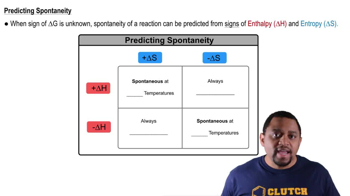
Temperature plays a crucial role in determining the spontaneity of a reaction, particularly when ΔH and ΔS have opposing signs. For reactions where ΔH is positive and ΔS is also positive, increasing the temperature can make ΔG negative, thus making the reaction spontaneous. Conversely, if ΔH is negative and ΔS is negative, lowering the temperature may be necessary to achieve spontaneity.
추천 영상:
가이드 코스
Spontaneity and Temperature
관련 실천
교과서 질문
2657
views
교과서 질문
For each reaction, calculate ΔH°rxn, ΔS°rxn, and ΔG°rxn at 25 °C and state whether or not the reaction is spontaneous. If the reaction is not spontaneous, would a change in temperature make it spontaneous? If so, should the temperature be raised or lowered from 25 °C? c. N2(g) + O2(g) → 2 NO(g)
1486
views
1
rank
교과서 질문
For each reaction, calculate ΔH°rxn, ΔS°rxn, and ΔG°rxn at 25 °C and state whether or not the reaction is spontaneous. If the reaction is not spontaneous, would a change in temperature make it spontaneous? If so, should the temperature be raised or lowered from 25 °C? a. 2 CH4(g) → C2H6(g) + H2(g)
742
views
