
Living organisms use energy from the metabolism of food to create an energy-rich molecule called adenosine triphosphate (ATP). The ATP acts as an energy source for a variety of reactions that the living organism must carry out to survive. ATP provides energy through its hydrolysis, which can be symbolized as follows: ATP(aq) + H2O(l) → ADP(aq) + Pi(aq) ΔG°rxn = -30.5 kJ where ADP represents adenosine diphosphate and Pi represents an inorganic phosphate group (such as HPO42-). b. The free energy obtained from the oxidation (reaction with oxygen) of glucose (C6H12O6) to form carbon dioxide and water can be used to re-form ATP by driving the given reaction in reverse. Calculate the standard free energy change for the oxidation of glucose and estimate the maximum number of moles of ATP that can be formed by the oxidation of one mole of glucose.

- Ch.1 - Matter, Measurement & Problem Solving136
- Ch.2 - Atoms & Elements112
- Ch.3 - Molecules, Compounds & Chemical Equations159
- Ch.4 - Chemical Quantities & Aqueous Reactions140
- Ch.5 - Gases118
- Ch.6 - Thermochemistry106
- Ch.7 - Quantum-Mechanical Model of the Atom62
- Ch.8 - Periodic Properties of the Elements103
- Ch.9 - Chemical Bonding I: The Lewis Model104
- Ch.10 - Chemical Bonding II: Molecular Shapes & Valence Bond Theory89
- Ch.11 - Liquids, Solids & Intermolecular Forces73
- Ch.12 - Solids and Modern Material59
- Ch.13 - Solutions110
- Ch.14 - Chemical Kinetics140
- Ch.15 - Chemical Equilibrium78
- Ch.16 - Acids and Bases155
- Ch.17 - Aqueous Ionic Equilibrium176
- Ch.18 - Free Energy and Thermodynamics108
- Ch.19 - Electrochemistry118
- Ch.20 - Radioactivity and Nuclear Chemistry82
- Ch.21 - Organic Chemistry150
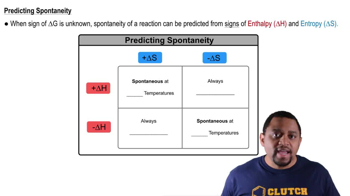
These reactions are important in catalytic converters in automobiles. Calculate ΔG° for each at 298 K. Predict the effect of increasing temperature on the magnitude of ΔG°.
a. 2 CO(g) + 2 NO(g) → N2(g) + 2 CO2(g)
b. 5 H2(g) + 2 NO(g) → 2 NH3(g) + 2 H2O(g)
c. 2 H2(g) + 2 NO(g) → N2(g) + 2 H2O(g)
d. 2 NH3(g) + 2 O2(g) → N2O(g) + 3 H2O(g)
 검증된 단계별 안내
비슷한 문제에 대한 검증된 영상 답변:

주요 개념
Gibbs Free Energy (ΔG)

 01:51
01:51
Temperature and Reaction Spontaneity
 01:17
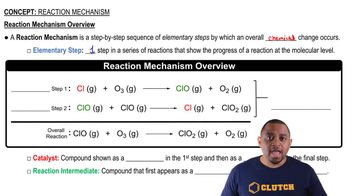
01:17Catalytic Converters and Reaction Mechanisms
 03:06
03:06Living organisms use energy from the metabolism of food to create an energy-rich molecule called adenosine triphosphate (ATP). The ATP acts as an energy source for a variety of reactions that the living organism must carry out to survive. ATP provides energy through its hydrolysis, which can be symbolized as follows: ATP(aq) + H2O(l) → ADP(aq) + Pi(aq) ΔGrxn ° = -30.5 kJ where ADP represents adenosine diphosphate and Pi represents an inorganic phosphate group (such as HPO42-). a. Calculate the equilibrium constant, K, for the given reaction at 298 K.
All the oxides of nitrogen have positive values of ΔG°f at 298 K, but only one common oxide of nitrogen has a positive ΔS°f. Identify that oxide of nitrogen without reference to thermodynamic data and explain.
The values of ΔG°f for the hydrogen halides become less negative with increasing atomic number. The ΔG°f of HI is slightly positive. However, the trend in ΔS°f is to become more positive with increasing atomic number. Explain.
Calculate ΔG° at 298 K for these reactions and predict the effect on ΔG° of lowering the temperature.
a. NH3(g) + HBr(g) → NH4Br(s)
b. CaCO3(s) → CaO(s) + CO2(g)
c. CH4(g) + 3 Cl2(g) → CHCl3(g) + 3 HCl(g) (ΔG°f for CHCl3(g) is -70.4 kJ/mol.)