
Ch.19 - Electrochemistry
Tro - Chemistry: A Molecular Approach 4th Edition
Tro4th EditionChemistry: A Molecular ApproachISBN: 9780134112831당신이 사용하는 게 아니라요?교과서 변경
19장, 문제 115b

A battery relies on the oxidation of magnesium and the reduction of Cu2+. The initial concentrations of Mg2+ and Cu2+ are 1.0 × 10⁻⁴ M and 1.5 M, respectively, in 1.0-liter half-cells. b. What is the voltage of the battery after delivering 5.0 A for 8.0 h?

검증된 단계별 안내
1
1. First, we need to understand the reactions occurring in the battery. The oxidation of magnesium (Mg) is Mg -> Mg2+ + 2e-. The reduction of Cu2+ is Cu2+ + 2e- -> Cu. These reactions together form the overall reaction: Mg + Cu2+ -> Mg2+ + Cu.
2. Next, we need to calculate the amount of charge transferred. The current (I) is 5.0 A and the time (t) is 8.0 h. The charge (Q) transferred can be calculated using the formula Q = It. Note that 1 A = 1 C/s and 1 h = 3600 s. So, convert the time to seconds before calculating the charge.
3. The charge calculated in step 2 is in coulombs (C). We need to convert this to moles of electrons. We can do this using Faraday's constant (F), which is approximately 96485 C/mol. The number of moles of electrons (n) can be calculated using the formula n = Q/F.
4. Now, we need to calculate the new concentrations of Mg2+ and Cu2+. For every mole of Mg oxidized, one mole of Mg2+ is produced and for every two moles of electrons, one mole of Cu2+ is reduced. So, the change in concentration of Mg2+ is equal to the number of moles of electrons and the change in concentration of Cu2+ is half the number of moles of electrons. Subtract these changes from the initial concentrations to get the new concentrations.
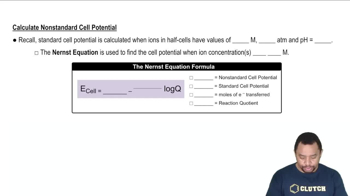
5. Finally, we can calculate the voltage of the battery using the Nernst equation: E = E0 - (RT/nF) * ln(Q), where E0 is the standard cell potential, R is the gas constant, T is the temperature in Kelvin, n is the number of moles of electrons transferred in the balanced chemical equation, F is Faraday's constant, and Q is the reaction quotient. The reaction quotient Q is equal to [Mg2+]/[Cu2+]. Use the new concentrations calculated in step 4 to calculate Q. Note that the standard cell potential E0 and the temperature T are not given in the problem, so you will need to look up E0 and assume a standard temperature (such as 298 K).

비슷한 문제에 대한 검증된 영상 답변:

이 영상 해법은 위 문제에 도움이 된다고 튜터들이 추천한 것입니다.
영상 길이:
13m

주요 개념

질문에 올바르게 답하기 위해 반드시 이해해야 하는 핵심 개념들은 다음과 같습니다.

Electrochemical Reactions

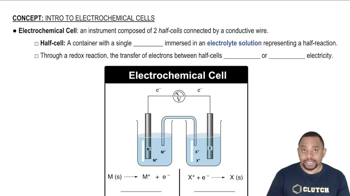
Electrochemical reactions involve the transfer of electrons between species, where oxidation refers to the loss of electrons and reduction refers to the gain of electrons. In this battery scenario, magnesium (Mg) is oxidized, losing electrons, while copper ions (Cu2+) are reduced, gaining electrons. Understanding these processes is crucial for analyzing how batteries generate electrical energy.
추천 영상:
가이드 코스
02:46
Electrochemical Cells

Nernst Equation

The Nernst equation relates the concentration of reactants and products to the cell potential (voltage) of an electrochemical cell. It allows for the calculation of the voltage under non-standard conditions, taking into account the concentrations of Mg2+ and Cu2+. This equation is essential for determining how the voltage changes as the reaction proceeds and concentrations shift.
추천 영상:
가이드 코스
01:17
The Nernst Equation

Current and Charge

Current (measured in amperes) is the flow of electric charge, and it is related to the amount of charge transferred over time. In this problem, delivering 5.0 A for 8.0 hours means calculating the total charge (in coulombs) that has passed through the circuit. This charge can be used to determine how much of the reactants have been consumed, affecting the concentrations and, consequently, the voltage of the battery.
추천 영상: