Ch.19 - Electrochemistry
Tro - Chemistry: A Molecular Approach 4th Edition
Tro4th EditionChemistry: A Molecular ApproachISBN: 9780134112831당신이 사용하는 게 아니라요?교과서 변경
19장, 문제 86

Refer to the tabulated values of ∆G°f in Appendix IIB to calculate E°cell for the fuel-cell breathalyzer, which employs the following reaction. ((∆G° for HC2H3O2(g) = -374.2 kJ/mol.)
CH3CH2OH(g) + O2(g) → HC2H3O2(g) + H2O(g)

검증된 단계별 안내
1
Identify the given reaction: \( \text{CH}_3\text{CH}_2\text{OH(g)} + \text{O}_2\text{(g)} \rightarrow \text{HC}_2\text{H}_3\text{O}_2\text{(g)} + \text{H}_2\text{O(g)} \).
Use the formula \( \Delta G^\circ = -nFE^\circ_{\text{cell}} \) to relate \( \Delta G^\circ \) and \( E^\circ_{\text{cell}} \), where \( n \) is the number of moles of electrons transferred and \( F \) is the Faraday constant (96485 C/mol).
Calculate \( \Delta G^\circ \) for the reaction using \( \Delta G^\circ = \sum \Delta G^\circ_f(\text{products}) - \sum \Delta G^\circ_f(\text{reactants}) \).
Determine the number of moles of electrons transferred, \( n \), by balancing the redox reaction.
Solve for \( E^\circ_{\text{cell}} \) using the rearranged formula \( E^\circ_{\text{cell}} = -\frac{\Delta G^\circ}{nF} \).

비슷한 문제에 대한 검증된 영상 답변:

이 영상 해법은 위 문제에 도움이 된다고 튜터들이 추천한 것입니다.
영상 길이:
4m

주요 개념

질문에 올바르게 답하기 위해 반드시 이해해야 하는 핵심 개념들은 다음과 같습니다.

Gibbs Free Energy (∆G)

Gibbs Free Energy (∆G) is a thermodynamic potential that measures the maximum reversible work obtainable from a thermodynamic system at constant temperature and pressure. It indicates the spontaneity of a reaction; a negative ∆G value suggests that the reaction can occur spontaneously, while a positive value indicates non-spontaneity. In the context of fuel cells, understanding ∆G helps in evaluating the efficiency and feasibility of the chemical reactions involved.
추천 영상:
가이드 코스
01:51
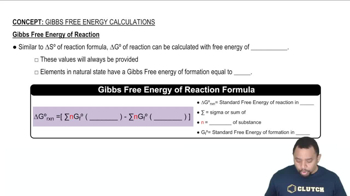
Gibbs Free Energy of Reactions

Standard Gibbs Free Energy of Formation (∆Gf°)

The Standard Gibbs Free Energy of Formation (∆Gf°) is the change in Gibbs free energy when one mole of a compound is formed from its elements in their standard states. This value is crucial for calculating the overall Gibbs free energy change of a reaction by using the formula: ∆G° = Σ∆Gf°(products) - Σ∆Gf°(reactants). It provides insight into the stability of compounds and the energy changes during chemical reactions.
추천 영상:
가이드 코스
00:32
Standard Gibbs Free Energy and Temperature

Electrochemical Cell Potential (Ec°ell)

Electrochemical Cell Potential (Ec°ell) is the measure of the voltage or electromotive force (EMF) generated by an electrochemical cell under standard conditions. It is related to the Gibbs free energy change of the reaction by the equation ∆G° = -nFEc°ell, where n is the number of moles of electrons transferred and F is Faraday's constant. Understanding this relationship is essential for evaluating the performance of fuel cells, such as those used in breathalyzers.
추천 영상:
가이드 코스
02:46
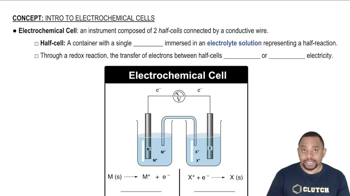
Electrochemical Cells