Ch.20 - Radioactivity and Nuclear Chemistry
Tro - Chemistry: A Molecular Approach 4th Edition
Tro4th EditionChemistry: A Molecular ApproachISBN: 9780134112831당신이 사용하는 게 아니라요?교과서 변경
20장, 문제 65

If 1.0 g of matter is converted to energy, how much energy is formed?

검증된 단계별 안내
1
insert step 1> Determine the formula to use for converting mass to energy. The relevant equation is Einstein's mass-energy equivalence formula: \(E = mc^2\), where \(E\) is energy, \(m\) is mass, and \(c\) is the speed of light in a vacuum.
insert step 2> Identify the given values in the problem. Here, the mass \(m\) is 1.0 g. Note that the speed of light \(c\) is a constant, approximately \(3.00 \times 10^8\) m/s.
insert step 3> Convert the mass from grams to kilograms, since the standard unit of mass in physics is kilograms. Remember that 1 kg = 1000 g, so 1.0 g = 0.001 kg.
insert step 4> Substitute the values into the equation \(E = mc^2\). Use \(m = 0.001\) kg and \(c = 3.00 \times 10^8\) m/s.
insert step 5> Calculate the energy \(E\) by performing the multiplication. This will give you the energy in joules (J), which is the standard unit of energy in the International System of Units (SI).

비슷한 문제에 대한 검증된 영상 답변:

이 영상 해법은 위 문제에 도움이 된다고 튜터들이 추천한 것입니다.
영상 길이:
1m

주요 개념

질문에 올바르게 답하기 위해 반드시 이해해야 하는 핵심 개념들은 다음과 같습니다.

Einstein's Mass-Energy Equivalence

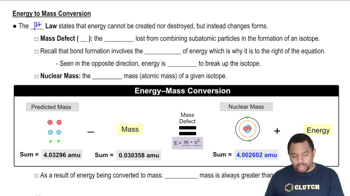
Einstein's mass-energy equivalence principle, expressed by the equation E=mc², states that mass can be converted into energy. In this equation, E represents energy, m is mass, and c is the speed of light in a vacuum (approximately 3.00 x 10^8 m/s). This principle underlies nuclear reactions and explains how a small amount of mass can yield a large amount of energy.
추천 영상:
가이드 코스
04:12
Energy to Mass Conversion

Unit Conversion

In chemistry and physics, unit conversion is essential for accurately calculating quantities. When converting mass to energy using E=mc², it is crucial to ensure that the mass is in kilograms (kg) since the speed of light is in meters per second (m/s). For example, 1.0 g of matter must be converted to kilograms (1.0 g = 0.001 kg) before applying the equation.
추천 영상:
가이드 코스
01:56
Conversion Factors

Energy Units

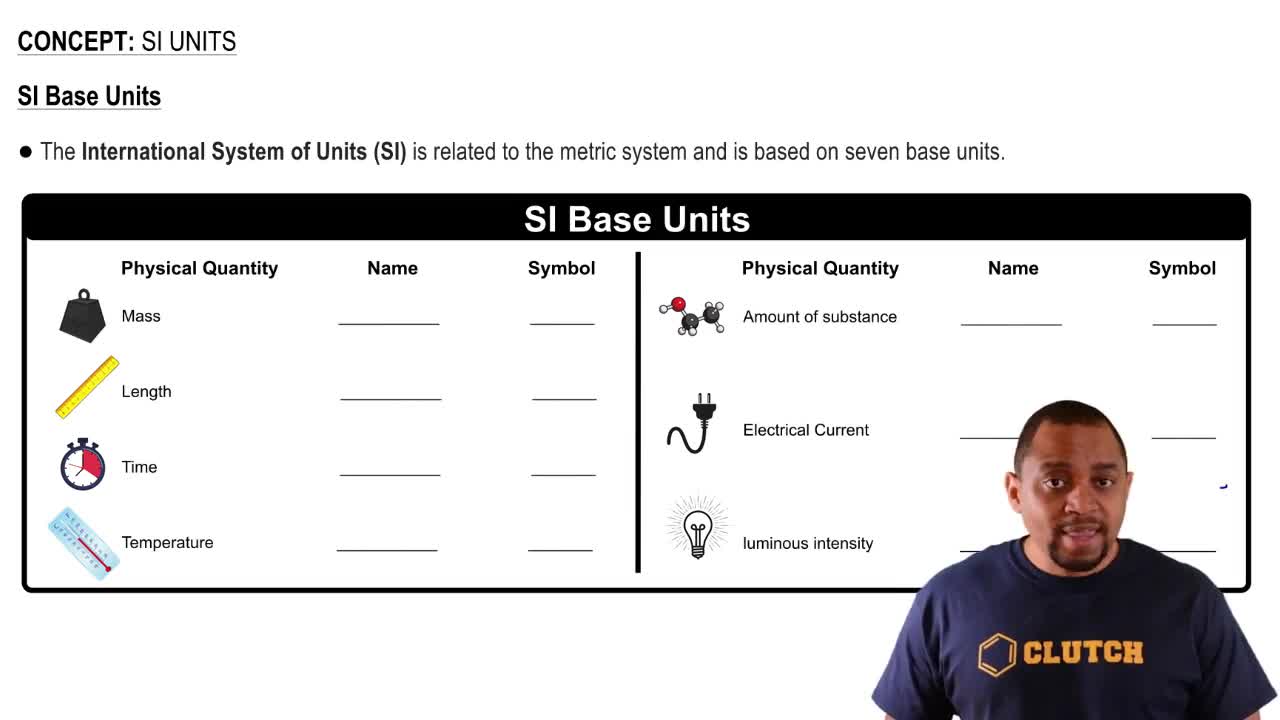
Energy is commonly measured in joules (J) in the International System of Units (SI). Understanding how to express energy in joules is important when calculating the energy produced from mass conversion. For instance, using E=mc² with the correct mass in kilograms will yield the energy in joules, allowing for a clear understanding of the energy produced from the conversion of matter.
추천 영상: