Ch.3 - Molecules, Compounds & Chemical Equations
Tro - Chemistry: A Molecular Approach 4th Edition
Tro4th EditionChemistry: A Molecular ApproachISBN: 9780134112831당신이 사용하는 게 아니라요?교과서 변경
3장, 문제 112

Balance each chemical equation. a. Na2S(aq) + Cu(NO3)2(aq) → NaNO3(aq) + CuS(s) b. N2H4(l) → NH3(g) + N2(g) c. HCl(aq) + O2(g) → H2O(l) + Cl2(g) d. FeS(s) + HCl(aq) → FeCl2(aq) + H2S(g)

검증된 단계별 안내
1
Step 1: For equation (a), start by balancing the number of sodium (Na) atoms. There are 2 Na atoms in Na2S, so ensure there are 2 Na atoms in NaNO3 by placing a coefficient of 2 in front of NaNO3.
Step 2: Next, balance the sulfur (S) atoms in equation (a). There is 1 S atom in both Na2S and CuS, so they are already balanced.
Step 3: Balance the copper (Cu) atoms in equation (a). There is 1 Cu atom in both Cu(NO3)2 and CuS, so they are balanced.
Step 4: Balance the nitrate (NO3) groups in equation (a). There are 2 NO3 groups in Cu(NO3)2, so ensure there are 2 NO3 groups in NaNO3 by placing a coefficient of 2 in front of NaNO3.
Step 5: For equation (b), balance the nitrogen (N) atoms. There are 2 N atoms in N2H4, so ensure there are 2 N atoms in the products by having 1 N2 molecule and 2 NH3 molecules.

비슷한 문제에 대한 검증된 영상 답변:

이 영상 해법은 위 문제에 도움이 된다고 튜터들이 추천한 것입니다.
영상 길이:
5m

주요 개념

질문에 올바르게 답하기 위해 반드시 이해해야 하는 핵심 개념들은 다음과 같습니다.

Law of Conservation of Mass

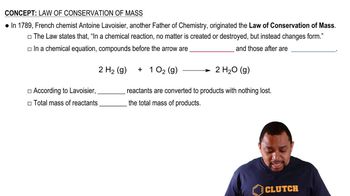
The Law of Conservation of Mass states that matter cannot be created or destroyed in a chemical reaction. This principle is fundamental when balancing chemical equations, as it requires that the number of atoms of each element must be the same on both sides of the equation. Understanding this law helps ensure that all reactants and products are accounted for in the balanced equation.
추천 영상:
가이드 코스
01:48
Law of Conservation of Mass

Stoichiometry

Stoichiometry is the calculation of reactants and products in chemical reactions based on the balanced equation. It involves using mole ratios derived from the coefficients of the balanced equation to determine the amounts of substances involved. Mastery of stoichiometry is essential for accurately balancing equations and predicting the outcomes of chemical reactions.
추천 영상:
가이드 코스
01:16
Stoichiometry Concept

Types of Chemical Reactions

Recognizing the types of chemical reactions—such as synthesis, decomposition, single replacement, and double replacement—can aid in balancing equations. Each type has specific patterns and rules that can simplify the balancing process. Understanding these categories allows for a more strategic approach to identifying how reactants transform into products.
추천 영상:
가이드 코스
02:25
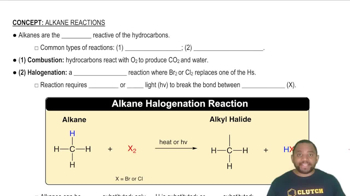
Common Types of Alkane Reactions