Ch.5 - Gases
Tro - Chemistry: A Molecular Approach 4th Edition
Tro4th EditionChemistry: A Molecular ApproachISBN: 9780134112831당신이 사용하는 게 아니라요?교과서 변경
5장, 문제 56

A sample of N2O gas has a density of 2.85 g/L at 298 K. What is the pressure of the gas (in mmHg)?

검증된 단계별 안내
1
Identify the ideal gas law equation: \( PV = nRT \).
Express the number of moles \( n \) in terms of mass and molar mass: \( n = \frac{m}{M} \), where \( m \) is mass and \( M \) is molar mass.
Substitute \( n = \frac{m}{M} \) into the ideal gas law to get \( PV = \frac{m}{M}RT \).
Rearrange the equation to solve for pressure \( P \): \( P = \frac{mRT}{MV} \).
Use the density formula \( \text{density} = \frac{m}{V} \) to substitute \( m/V \) with density in the pressure equation: \( P = \frac{\text{density} \times RT}{M} \).

비슷한 문제에 대한 검증된 영상 답변:

이 영상 해법은 위 문제에 도움이 된다고 튜터들이 추천한 것입니다.
영상 길이:
3m

주요 개념

질문에 올바르게 답하기 위해 반드시 이해해야 하는 핵심 개념들은 다음과 같습니다.

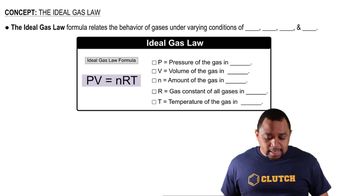
Ideal Gas Law

The Ideal Gas Law is a fundamental equation in chemistry that relates the pressure, volume, temperature, and number of moles of a gas. It is expressed as PV = nRT, where P is pressure, V is volume, n is the number of moles, R is the ideal gas constant, and T is temperature in Kelvin. This law allows us to calculate one variable if the others are known, making it essential for solving gas-related problems.
추천 영상:
가이드 코스
01:15
Ideal Gas Law Formula

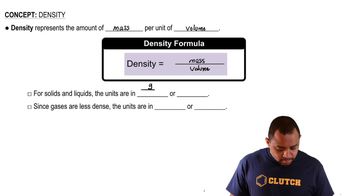
Density of Gases

The density of a gas is defined as its mass per unit volume, typically expressed in grams per liter (g/L). For gases, density can be influenced by temperature and pressure, and it can be calculated using the formula density = mass/volume. Understanding how to manipulate this relationship is crucial for converting density into other gas properties, such as pressure.
추천 영상:
가이드 코스
01:56
Density Concepts

Conversion of Units

In chemistry, it is often necessary to convert between different units of measurement, such as from grams to moles or from liters to milliliters. For this problem, converting pressure from atmospheres or pascals to mmHg is essential, as different contexts may require different units. Familiarity with conversion factors and the relationships between units is vital for accurate calculations.
추천 영상:
가이드 코스
01:56
Conversion Factors