Ch.5 - Gases
Tro - Chemistry: A Molecular Approach 4th Edition
Tro4th EditionChemistry: A Molecular ApproachISBN: 9780134112831당신이 사용하는 게 아니라요?교과서 변경
5장, 문제 126

A sample of N2O3(g) has a pressure of 0.017 atm. The temperature (in K) is doubled and the N2O3 undergoes complete decomposition to NO2(g) and NO(g). Find the total pressure of the mixture of gases assuming constant volume and no additional temperature change.

검증된 단계별 안내
1
Identify the initial conditions: The initial pressure of N2O3 is 0.017 atm.
Write the balanced chemical equation for the decomposition: N2O3(g) → NO2(g) + NO(g).
Determine the mole ratio from the balanced equation: 1 mole of N2O3 produces 1 mole of NO2 and 1 mole of NO.
Apply the ideal gas law concept: Since the volume is constant and temperature is doubled, the pressure of each gas will also double.
Calculate the total pressure: Add the pressures of NO2 and NO, considering the initial pressure of N2O3 and the effect of temperature doubling.

비슷한 문제에 대한 검증된 영상 답변:

이 영상 해법은 위 문제에 도움이 된다고 튜터들이 추천한 것입니다.
영상 길이:
4m

주요 개념

질문에 올바르게 답하기 위해 반드시 이해해야 하는 핵심 개념들은 다음과 같습니다.

Ideal Gas Law

The Ideal Gas Law relates the pressure, volume, temperature, and number of moles of a gas through the equation PV = nRT. This law is essential for understanding how changes in temperature and pressure affect gas behavior. In this scenario, the initial pressure of N2O3 and the effects of temperature doubling on gas pressure are analyzed using this principle.
추천 영상:
가이드 코스
01:15
Ideal Gas Law Formula

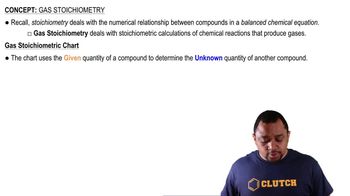
Stoichiometry of Gas Reactions

Stoichiometry involves the calculation of reactants and products in chemical reactions. For the decomposition of N2O3 into NO2 and NO, the stoichiometric coefficients indicate the molar relationships between the gases produced. Understanding these relationships is crucial for determining the total pressure of the gas mixture after the reaction.
추천 영상:
가이드 코스
00:47
Gas Stoichiometry Concepts

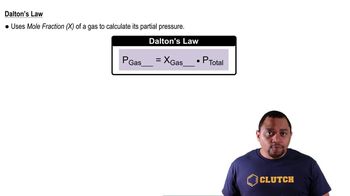
Dalton's Law of Partial Pressures

Dalton's Law states that the total pressure of a gas mixture is equal to the sum of the partial pressures of each individual gas. This concept is vital for calculating the total pressure after the decomposition of N2O3, as it allows for the addition of the partial pressures of NO2 and NO produced from the reaction, assuming no volume change.
추천 영상:
가이드 코스
00:27
Dalton's Law and Partial Pressure