Ch.5 - Gases
Tro - Chemistry: A Molecular Approach 4th Edition
Tro4th EditionChemistry: A Molecular ApproachISBN: 9780134112831당신이 사용하는 게 아니라요?교과서 변경
5장, 문제 79

Chlorine gas reacts with fluorine gas to form chlorine trifluoride. Cl2(g) + 3 F2(g) → 2 ClF3(g) A 2.00-L reaction vessel, initially at 298 K, contains chlorine gas at a partial pressure of 337 mmHg and fluorine gas at a partial pressure of 729 mmHg. Identify the limiting reactant. Determine the theoretical yield of ClF3 in grams.

검증된 단계별 안내
1
Identify the balanced chemical equation: \( \text{Cl}_2(g) + 3 \text{F}_2(g) \rightarrow 2 \text{ClF}_3(g) \).
Convert the partial pressures of \( \text{Cl}_2 \) and \( \text{F}_2 \) to moles using the ideal gas law: \( PV = nRT \). Assume \( R = 0.0821 \text{ L atm K}^{-1} \text{ mol}^{-1} \) and convert pressures from mmHg to atm.
Determine the mole ratio from the balanced equation and compare the mole ratio of available \( \text{Cl}_2 \) and \( \text{F}_2 \) to find the limiting reactant.
Calculate the moles of \( \text{ClF}_3 \) produced using the stoichiometry of the reaction based on the limiting reactant.
Convert the moles of \( \text{ClF}_3 \) to grams using its molar mass (\( \text{ClF}_3 \) molar mass = 92.45 g/mol).

비슷한 문제에 대한 검증된 영상 답변:

이 영상 해법은 위 문제에 도움이 된다고 튜터들이 추천한 것입니다.
영상 길이:
7m

주요 개념

질문에 올바르게 답하기 위해 반드시 이해해야 하는 핵심 개념들은 다음과 같습니다.

Limiting Reactant

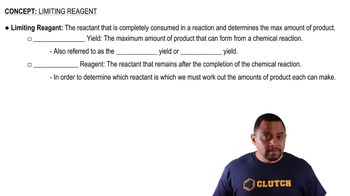
The limiting reactant is the substance that is completely consumed first in a chemical reaction, thus determining the maximum amount of product that can be formed. To identify the limiting reactant, one must compare the mole ratios of the reactants based on the balanced chemical equation and the initial amounts available. In this case, the stoichiometry of the reaction Cl2 + 3F2 → 2ClF3 will guide the analysis.
추천 영상:
가이드 코스
01:30
Limiting Reagent Concept

Partial Pressure

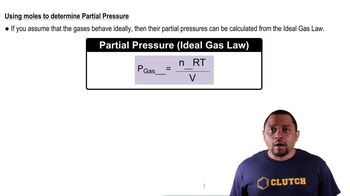
Partial pressure is the pressure exerted by a single component of a gas mixture. According to Dalton's Law of Partial Pressures, the total pressure of a gas mixture is the sum of the partial pressures of each individual gas. In this question, the partial pressures of chlorine and fluorine gases are crucial for calculating the number of moles available for the reaction, which is necessary for determining the limiting reactant.
추천 영상:
가이드 코스
00:48
Partial Pressure Calculation

Theoretical Yield

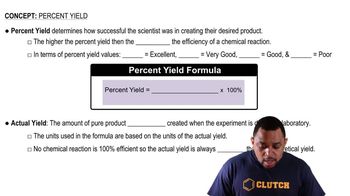
Theoretical yield is the maximum amount of product that can be produced from a given amount of reactants, assuming complete conversion and no losses. It is calculated using the stoichiometry of the balanced equation and the limiting reactant. Once the limiting reactant is identified, the theoretical yield of ClF3 can be determined by converting moles of the limiting reactant to grams using its molar mass.
추천 영상:
가이드 코스
03:09
Percent Yield in Reactions
관련 실천
교과서 질문

A flask at room temperature contains exactly equal amounts (in moles) of nitrogen and xenon. a. Which of the two gases exerts the greater partial pressure?

1666
views

교과서 질문

Lithium reacts with nitrogen gas according to the reaction: 6 Li(s) + N2(g) → 2 Li3N(s) What mass of lithium (in g) reacts completely with 58.5 mL of N2 gas at STP?

1730
views
교과서 질문

Carbon monoxide gas reacts with hydrogen gas to form methanol. CO(g) + 2 H2(g) → CH3OH(g) A 1.50-L reaction vessel, initially at 305 K, contains carbon monoxide gas at a partial pressure of 232 mmHg and hydrogen gas at a partial pressure of 397 mmHg. Identify the limiting reactant. Determine the theoretical yield of methanol in grams.

11932
views
교과서 질문

Ozone is depleted in the stratosphere by chlorine from CF3Cl according to this set of equations:

CF3Cl + UV light → CF3 + Cl

Cl + O3 → ClO + O2

O3 + UV light → O2 + O

ClO + O → Cl + O2

What total volume of ozone at a pressure of 25.0 mmHg and a temperature of 225 K is destroyed when all of the chlorine from 15.0 g of CF3Cl goes through 10 cycles of the given reactions?

1494
views
교과서 질문

Hydrogen gas (a potential future fuel) can be formed by the reaction of methane with water according to the equation: CH4(g) + H2O(g) → CO(g) + 3 H2(g) In a particular reaction, 25.5 L of methane gas (measured at a pressure of 732 torr and a temperature of 25 °C) mixes with 22.8 L of water vapor (measured at a pressure of 702 torr and a temperature of 125 °C). The reaction produces 26.2 L of hydrogen gas at STP. What is the percent yield of the reaction?

5161
views
교과서 질문

Consider a 1.0-L sample of helium gas and a 1.0-L sample of argon gas, both at room temperature and atmospheric pressure. a. Do the atoms in the helium sample have the same average kinetic energy as the atoms in the argon sample?

1350
views