
Ch.6 - Thermochemistry
Tro - Chemistry: A Molecular Approach 4th Edition
Tro4th EditionChemistry: A Molecular ApproachISBN: 9780134112831당신이 사용하는 게 아니라요?교과서 변경
6장, 문제 68

A 2.85-g lead weight, initially at 10.3 °C, is submerged in 7.55 g of water at 52.3 °C in an insulated container. What is the final temperature of both substances at thermal equilibrium?

검증된 단계별 안내
1
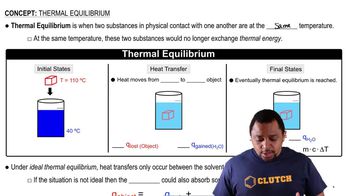
Identify the concept of thermal equilibrium, where the heat lost by the hotter substance (water) equals the heat gained by the cooler substance (lead).
Use the formula for heat transfer: \( q = mc\Delta T \), where \( q \) is the heat absorbed or released, \( m \) is the mass, \( c \) is the specific heat capacity, and \( \Delta T \) is the change in temperature.
Set up the equation for thermal equilibrium: \( m_{\text{lead}}c_{\text{lead}}(T_f - T_{\text{initial, lead}}) = -m_{\text{water}}c_{\text{water}}(T_f - T_{\text{initial, water}}) \).
Substitute the known values: \( m_{\text{lead}} = 2.85 \text{ g} \), \( c_{\text{lead}} = 0.128 \text{ J/g°C} \), \( T_{\text{initial, lead}} = 10.3 \text{ °C} \), \( m_{\text{water}} = 7.55 \text{ g} \), \( c_{\text{water}} = 4.18 \text{ J/g°C} \), \( T_{\text{initial, water}} = 52.3 \text{ °C} \).
Solve the equation for \( T_f \), the final temperature, which will be the same for both substances at thermal equilibrium.

비슷한 문제에 대한 검증된 영상 답변:

이 영상 해법은 위 문제에 도움이 된다고 튜터들이 추천한 것입니다.

주요 개념

질문에 올바르게 답하기 위해 반드시 이해해야 하는 핵심 개념들은 다음과 같습니다.

Thermal Equilibrium

Thermal equilibrium occurs when two substances at different temperatures come into contact and exchange heat until they reach the same temperature. In this scenario, the lead weight and water will transfer heat between each other until they stabilize at a common final temperature, which can be calculated using the principle of conservation of energy.
추천 영상:
가이드 코스
02:35
Thermal Equilibrium

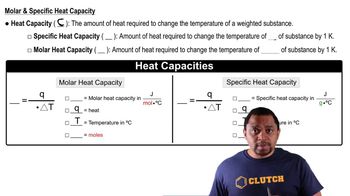
Specific Heat Capacity

Specific heat capacity is the amount of heat required to raise the temperature of a unit mass of a substance by one degree Celsius. Each material has a unique specific heat capacity, which influences how much its temperature changes when heat is added or removed. In this problem, the specific heat capacities of lead and water will be essential for calculating the final temperature.
추천 영상:

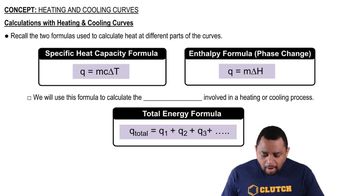
Heat Transfer Calculation

Heat transfer calculations involve determining the amount of heat lost or gained by a substance during a temperature change. This is typically expressed using the formula Q = mcΔT, where Q is the heat transferred, m is the mass, c is the specific heat capacity, and ΔT is the change in temperature. In this case, the heat lost by the water will equal the heat gained by the lead weight, allowing for the calculation of the final equilibrium temperature.
추천 영상:
가이드 코스
01:05
Calculations with Heating and Cooling Curves
관련 실천
교과서 질문

Exactly 1.5 g of a fuel burns under conditions of constant pressure and then again under conditions of constant volume. In measurement A the reaction produces 25.9 kJ of heat, and in measurement B the reaction produces 23.3 kJ of heat. Which measurement (A or B) corresponds to conditions of constant pressure? Explain.

1447
views
교과서 질문

Two substances, A and B, initially at different temperatures, come into contact and reach thermal equilibrium. The mass of substance A is 6.15 g and its initial temperature is 20.5 °C. The mass of substance B is 25.2 g and its initial temperature is 52.7 °C. The final temperature of both substances at thermal equilibrium is 46.7 °C. If the specific heat capacity of substance B is 1.17 J/g•°C, what is the specific heat capacity of substance A?

3164
views
1
rank
교과서 질문

A 31.1-g wafer of pure gold, initially at 69.3 °C, is submerged into 64.2 g of water at 27.8 °C in an insulated container. What is the final temperature of both substances at thermal equilibrium?

4111
views
4
rank
2
comments
교과서 질문

A 32.5-g iron rod, initially at 22.7 °C, is submerged into an unknown mass of water at 63.2 °C, in an insulated container. The final temperature of the mixture upon reaching thermal equilibrium is 59.5 °C. What is the mass of the water?

4045
views
교과서 질문

A silver block, initially at 58.5 °C, is submerged into 100.0 g of water at 24.8 °C, in an insulated container. The final temperature of the mixture upon reaching thermal equilibrium is 26.2 °C. What is the mass of the silver block?

2677
views
1
comments