Ch.6 - Thermochemistry
Tro - Chemistry: A Molecular Approach 4th Edition
Tro4th EditionChemistry: A Molecular ApproachISBN: 9780134112831당신이 사용하는 게 아니라요?교과서 변경
6장, 문제 46

A kilogram of aluminum metal and a kilogram of water are each warmed to 75 °C and placed in two identical insulated containers. One hour later, the two containers are opened and the temperature of each substance is measured. The aluminum has cooled to 35 °C, while the water has cooled only to 66 °C. Explain this difference.

검증된 단계별 안내
1
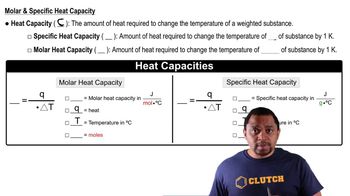
Understand the concept of specific heat capacity, which is the amount of heat required to raise the temperature of one kilogram of a substance by one degree Celsius. Different substances have different specific heat capacities.
Recognize that aluminum and water have different specific heat capacities. Water has a higher specific heat capacity than aluminum, meaning it can store more heat energy per kilogram per degree Celsius than aluminum.
Consider the initial conditions where both aluminum and water are heated to the same temperature. Despite being at the same temperature, the water, with its higher specific heat capacity, contains more total heat energy than the aluminum.
Analyze the cooling process in the insulated containers. Since water has a higher specific heat capacity, it releases heat more slowly than aluminum. This slower rate of heat loss results in a higher temperature compared to aluminum after one hour.
Conclude that the difference in temperature after cooling is due to the higher specific heat capacity of water compared to aluminum, which makes water retain heat longer and cool down at a slower rate.

비슷한 문제에 대한 검증된 영상 답변:

이 영상 해법은 위 문제에 도움이 된다고 튜터들이 추천한 것입니다.
영상 길이:
34s

주요 개념

질문에 올바르게 답하기 위해 반드시 이해해야 하는 핵심 개념들은 다음과 같습니다.

Specific Heat Capacity

Specific heat capacity is the amount of heat required to raise the temperature of one gram of a substance by one degree Celsius. Different materials have different specific heat capacities, which affects how they absorb and release heat. Water has a high specific heat capacity (4.18 J/g°C), meaning it can absorb a lot of heat without a significant change in temperature, while aluminum has a lower specific heat capacity (0.897 J/g°C), leading to a quicker temperature change.
추천 영상:

Thermal Equilibrium

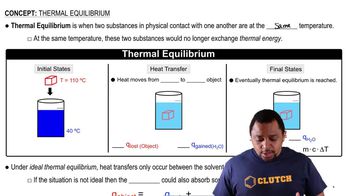
Thermal equilibrium occurs when two substances at different temperatures are in contact, and heat flows from the hotter substance to the cooler one until they reach the same temperature. In this scenario, the aluminum and water started at the same temperature but have different cooling rates due to their specific heat capacities, resulting in different final temperatures after one hour.
추천 영상:
가이드 코스
02:35
Thermal Equilibrium

Insulation and Heat Loss

Insulation refers to materials that reduce the rate of heat transfer between substances. In this experiment, the insulated containers minimize heat loss to the environment, allowing for a more accurate comparison of how the two substances cool. The difference in final temperatures is primarily due to the inherent properties of aluminum and water, rather than external heat loss.
추천 영상: