
Ch.6 - Thermochemistry
Tro - Chemistry: A Molecular Approach 4th Edition
Tro4th EditionChemistry: A Molecular ApproachISBN: 9780134112831당신이 사용하는 게 아니라요?교과서 변경
6장, 문제 41

A system releases 622 kJ of heat and does 105 kJ of work on the surroundings. What is the change in internal energy of the system?

검증된 단계별 안내
1
Identify the given values: heat released by the system (q) is -622 kJ (negative because it is released), and work done by the system on the surroundings (w) is -105 kJ (negative because work is done by the system).
Recall the first law of thermodynamics, which states that the change in internal energy of a system (\(\Delta U\)) is equal to the heat added to the system plus the work done on the system: \(\Delta U = q + w\).
Substitute the given values into the first law equation: \(\Delta U = -622 \text{ kJ} + (-105 \text{ kJ})\).
Calculate the sum of the heat and work values to find the change in internal energy.
Interpret the sign of your result to determine whether the internal energy of the system increased or decreased.

비슷한 문제에 대한 검증된 영상 답변:

이 영상 해법은 위 문제에 도움이 된다고 튜터들이 추천한 것입니다.

주요 개념

질문에 올바르게 답하기 위해 반드시 이해해야 하는 핵심 개념들은 다음과 같습니다.

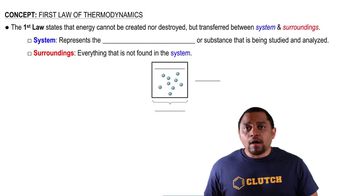
First Law of Thermodynamics

The First Law of Thermodynamics states that energy cannot be created or destroyed, only transformed. It establishes the relationship between the internal energy of a system, heat exchanged, and work done. Mathematically, it is expressed as ΔU = Q - W, where ΔU is the change in internal energy, Q is the heat added to the system, and W is the work done by the system.
추천 영상:
가이드 코스
01:18
First Law of Thermodynamics

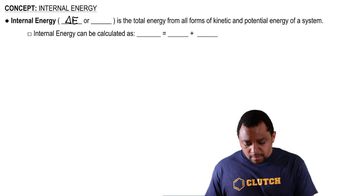
Internal Energy

Internal energy is the total energy contained within a system, encompassing both kinetic and potential energy at the molecular level. It reflects the energy associated with the temperature, phase, and composition of the system. Changes in internal energy occur due to heat transfer and work interactions with the surroundings.
추천 영상:
가이드 코스
00:40
Internal Energy

Sign Convention in Thermodynamics

In thermodynamics, a sign convention is crucial for correctly interpreting energy changes. Heat added to the system is considered positive, while heat released is negative. Similarly, work done by the system on the surroundings is negative, while work done on the system is positive. This convention helps in accurately applying the First Law of Thermodynamics.
추천 영상:
가이드 코스
01:18
First Law of Thermodynamics
관련 실천
교과서 질문

Identify each energy exchange as primarily heat or work and determine whether the sign of ΔE is positive or negative for the system. Identify each energy exchange as primarily heat or work. a. A rolling billiard ball collides with another billiard ball. The first billiard ball (defined as the system) stops rolling after the collision. b. A book falls to the floor. (The book is the system). c. A father pushes his daughter on a swing. (The daughter and the swing are the system). Identify each energy exchange as primarily heat or work.

916
views
교과서 질문

Identify each energy exchange as primarily heat or work and determine whether the sign of ΔE is positive or negative for the system. a. Sweat evaporates from skin, cooling the skin. (The evaporating sweat is the system.)

1193
views
1
rank
2
comments
교과서 질문

Identify each energy exchange as primarily heat or work and determine whether the sign of ΔE is positive or negative for the system. a. Sweat evaporates from skin, cooling the skin. (The evaporating sweat is the system.) b. A balloon expands against an external pressure. (The contents of the balloon is the system.) c. An aqueous chemical reaction mixture is warmed with an external flame. (The reaction mixture is the system.) Identify energy exchanges as primarily heat or work. Determine whether the sign of E is positive or negative for the system.

1287
views
교과서 질문

A system absorbs 196 kJ of heat and the surroundings do 117 kJ of work on the system. What is the change in internal energy of the system?

2906
views
교과서 질문

The air in an inflated balloon (defined as the system) warms over a toaster and absorbs 115 J of heat. As it expands, it does 77 kJ of work. What is the change in internal energy for the system?

1810
views
2
comments