Ch.7 - Quantum-Mechanical Model of the Atom
Tro - Chemistry: A Molecular Approach 4th Edition
Tro4th EditionChemistry: A Molecular ApproachISBN: 9780134112831당신이 사용하는 게 아니라요?교과서 변경
7장, 문제 45

Determine the energy of 1 mol of photons for each kind of light. (Assume three significant figures.) a. infrared radiation (1500 nm) b. visible light (500 nm) c. ultraviolet radiation (150 nm)

검증된 단계별 안내
1
Step 1: Recall the energy of a photon can be calculated using the equation: E = h * c / λ, where E is the energy, h is Planck's constant (6.626 x 10^-34 J*s), c is the speed of light (3.00 x 10^8 m/s), and λ is the wavelength.
Step 2: Convert the wavelength from nanometers to meters. 1 nm = 1 x 10^-9 m. So, 1500 nm = 1500 x 10^-9 m = 1.5 x 10^-6 m.
Step 3: Substitute the values into the equation to calculate the energy of one photon: E = (6.626 x 10^-34 J*s) * (3.00 x 10^8 m/s) / (1.5 x 10^-6 m).
Step 4: To find the energy of 1 mol of photons, multiply the energy of one photon by Avogadro's number (6.022 x 10^23). So, E(mol) = E * (6.022 x 10^23).
Step 5: The result from step 4 is the energy of 1 mol of infrared radiation photons.

비슷한 문제에 대한 검증된 영상 답변:

이 영상 해법은 위 문제에 도움이 된다고 튜터들이 추천한 것입니다.
영상 길이:
4m

주요 개념

질문에 올바르게 답하기 위해 반드시 이해해야 하는 핵심 개념들은 다음과 같습니다.

Photon Energy

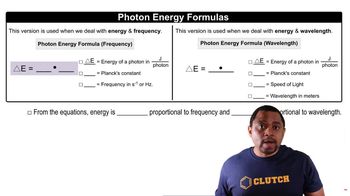
Photon energy is the energy carried by a single photon, which can be calculated using the equation E = hc/λ, where E is energy, h is Planck's constant, c is the speed of light, and λ is the wavelength of the light. This relationship shows that energy is inversely proportional to wavelength; shorter wavelengths correspond to higher energy photons.
추천 영상:
가이드 코스
01:40
Photon Energy Formulas

Wavelength and Frequency

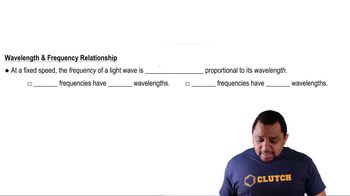
Wavelength and frequency are fundamental properties of electromagnetic radiation. Wavelength (λ) is the distance between successive peaks of a wave, while frequency (ν) is the number of wave cycles that pass a point per second. They are related by the equation c = λν, where c is the speed of light, indicating that as wavelength increases, frequency decreases.
추천 영상:
가이드 코스
00:31
Frequency-Wavelength Relationship

Moles and Avogadro's Number

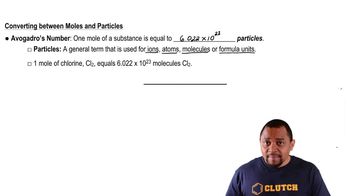
A mole is a unit in chemistry that represents 6.022 x 10²³ entities, such as atoms or photons. When calculating the energy of 1 mol of photons, it is essential to multiply the energy of a single photon by Avogadro's number to find the total energy for that amount of photons, allowing for practical calculations in chemical contexts.
추천 영상:
가이드 코스
02:41
Moles and Particles Conversion