Ch.10 - Chemical Bonding I: The Lewis Model
Tro - Chemistry: A Molecular Approach 5th Edition
Tro5th EditionChemistry: A Molecular ApproachISBN: 9780134874371당신이 사용하는 게 아니라요?교과서 변경
10장, 문제 58b

Refer to Figure 10.10 to estimate the percent ionic character of the BrF bond.

검증된 단계별 안내
1
Step 1: Understand the concept of percent ionic character. The percent ionic character of a bond is a measure of the degree to which electrons are transferred from one atom to another in a bond, as opposed to being shared equally.
Step 2: Identify the electronegativities of the atoms involved. Look up the electronegativity values for bromine (Br) and fluorine (F) from a reliable source, such as a periodic table with electronegativity values.
Step 3: Calculate the difference in electronegativity between the two atoms. Subtract the electronegativity of bromine from that of fluorine to find the difference.
Step 4: Use the electronegativity difference to estimate the percent ionic character. Typically, a larger difference in electronegativity indicates a higher percent ionic character. You may refer to a chart or graph (like Figure 10.10) that correlates electronegativity difference with percent ionic character.
Step 5: Interpret the result. Based on the chart or graph, determine the estimated percent ionic character of the BrF bond and understand what this implies about the nature of the bond (e.g., more ionic or more covalent).

비슷한 문제에 대한 검증된 영상 답변:

이 영상 해법은 위 문제에 도움이 된다고 튜터들이 추천한 것입니다.
영상 길이:
1m

주요 개념

질문에 올바르게 답하기 위해 반드시 이해해야 하는 핵심 개념들은 다음과 같습니다.

Ionic Character

Ionic character refers to the degree to which a bond between two atoms exhibits ionic properties, as opposed to covalent properties. It is determined by the difference in electronegativity between the two atoms involved in the bond. A higher electronegativity difference typically indicates a greater ionic character, leading to a bond that is more polar and has distinct positive and negative charges.
추천 영상:
가이드 코스
00:56
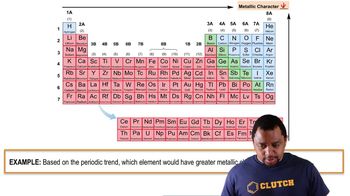
Metallic Character Example

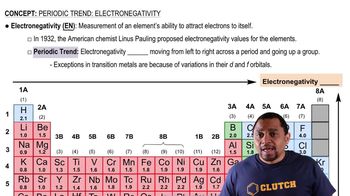
Electronegativity

Electronegativity is a measure of an atom's ability to attract and hold onto electrons in a chemical bond. The Pauling scale is commonly used to quantify electronegativity values, with fluorine being the most electronegative element. Understanding the electronegativity of bromine and fluorine is essential for estimating the ionic character of the BrF bond, as their values will indicate how the electrons are distributed in the bond.
추천 영상:
가이드 코스
02:10
Electronegativity Trends

Percent Ionic Character Calculation

The percent ionic character of a bond can be estimated using the formula: % Ionic Character = (1 - e^(-0.25 * (ΔEN)^2)) * 100, where ΔEN is the difference in electronegativity between the two atoms. This calculation provides a quantitative measure of how ionic the bond is, allowing for a clearer understanding of the bond's nature and its properties in various chemical contexts.
추천 영상:
가이드 코스
00:38
Mass Percent Calculation