Ch.15 - Chemical Kinetics
Tro - Chemistry: A Molecular Approach 5th Edition
Tro5th EditionChemistry: A Molecular ApproachISBN: 9780134874371당신이 사용하는 게 아니라요?교과서 변경
15장, 문제 106

Phosgene (Cl2CO), a poison gas used in World War I, is formed
by the reaction of Cl2 and CO. The proposed mechanism for the
reaction is:
Cl2Δ2 Cl (fast, equilibrium)
Cl + COΔClCO (fast, equilibrium)
ClCO + Cl2¡Cl2CO + Cl (slow)

검증된 단계별 안내
1
Identify the overall reaction by summing up the elementary steps in the proposed mechanism.
Determine the rate-determining step, which is the slowest step in the mechanism.
Write the rate law based on the rate-determining step, using the concentrations of the reactants involved in that step.
Since the rate-determining step involves intermediates, express the concentration of the intermediate in terms of the reactants using the fast equilibrium steps.
Substitute the expression for the intermediate back into the rate law to obtain the rate law in terms of the initial reactants.

비슷한 문제에 대한 검증된 영상 답변:

이 영상 해법은 위 문제에 도움이 된다고 튜터들이 추천한 것입니다.
영상 길이:
1m

주요 개념

질문에 올바르게 답하기 위해 반드시 이해해야 하는 핵심 개념들은 다음과 같습니다.

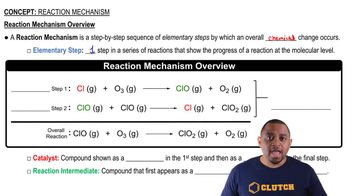
Reaction Mechanism

A reaction mechanism is a step-by-step description of the process by which reactants are converted into products. It outlines the individual elementary steps involved, including the formation and consumption of intermediates. Understanding the mechanism helps in predicting the rate of reaction and the effect of various conditions on the reaction's progress.
추천 영상:
가이드 코스
03:06
Reaction Mechanism Overview

Equilibrium

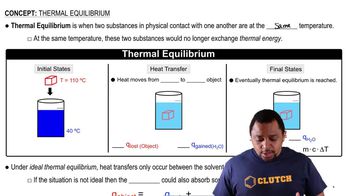
Equilibrium in a chemical reaction refers to the state where the rates of the forward and reverse reactions are equal, resulting in constant concentrations of reactants and products. In the context of the proposed mechanism, the fast steps are at equilibrium, meaning they can be represented by equilibrium constants, which influence the overall reaction dynamics.
추천 영상:
가이드 코스
02:35
Thermal Equilibrium

Rate-Determining Step

The rate-determining step (RDS) is the slowest step in a reaction mechanism that controls the overall reaction rate. In the provided mechanism, the last step is identified as the slow step, indicating that it has the highest activation energy and thus dictates how quickly the reaction proceeds. Understanding the RDS is crucial for optimizing reaction conditions and improving yields.
추천 영상:
가이드 코스
01:15
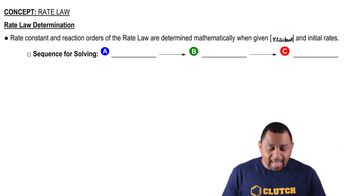
Rate Law Determination