Write the balanced chemical equation for the reaction of aqueous potassium hydroxide with aqueous iron(III) chloride to form solid iron(III) hydroxide and aqueous potassium chloride.
Ch.4 - Chemical Reactions and Chemical Quantities
4장, 문제 23
Balance each chemical equation. b. Co(NO3)3(aq) + (NH4)2S(aq) → Co2S3(s) + NH4NO3(aq)
검증된 단계별 안내1
Identify the number of each type of atom on both sides of the equation.
Start by balancing the metal cation, Co, by ensuring the number of Co atoms is the same on both sides.
Balance the sulfur atoms by adjusting the coefficient of (NH4)2S.
Balance the nitrogen atoms by adjusting the coefficient of NH4NO3.
Finally, balance the hydrogen and oxygen atoms, if necessary, by adjusting the coefficients of the compounds containing these elements.

비슷한 문제에 대한 검증된 영상 답변:
이 영상 해법은 위 문제에 도움이 된다고 튜터들이 추천한 것입니다.
영상 길이:
5m주요 개념
질문에 올바르게 답하기 위해 반드시 이해해야 하는 핵심 개념들은 다음과 같습니다.
Balancing Chemical Equations
Balancing chemical equations involves ensuring that the number of atoms for each element is the same on both sides of the equation. This is based on the law of conservation of mass, which states that matter cannot be created or destroyed in a chemical reaction. Coefficients are used to adjust the number of molecules or formula units to achieve balance.
추천 영상:
가이드 코스
Balancing Chemical Equations
Types of Chemical Reactions
Understanding the types of chemical reactions, such as double displacement, is crucial for balancing equations. In this case, the reaction between cobalt(III) nitrate and ammonium sulfide is a double displacement reaction, where the cations and anions exchange partners. Recognizing the type of reaction helps predict the products and their states.
추천 영상:
가이드 코스
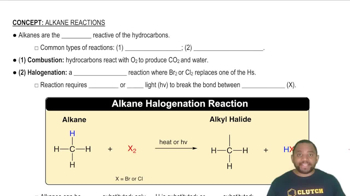
Common Types of Alkane Reactions
States of Matter in Chemical Reactions
The states of matter (solid, liquid, gas, aqueous) in a chemical equation provide important information about the reactants and products. In the given equation, Co(NO3)3 and (NH4)2S are in aqueous solution, while Co2S3 is a solid precipitate. Understanding these states helps in visualizing the reaction and determining the physical changes that occur.
추천 영상:
가이드 코스
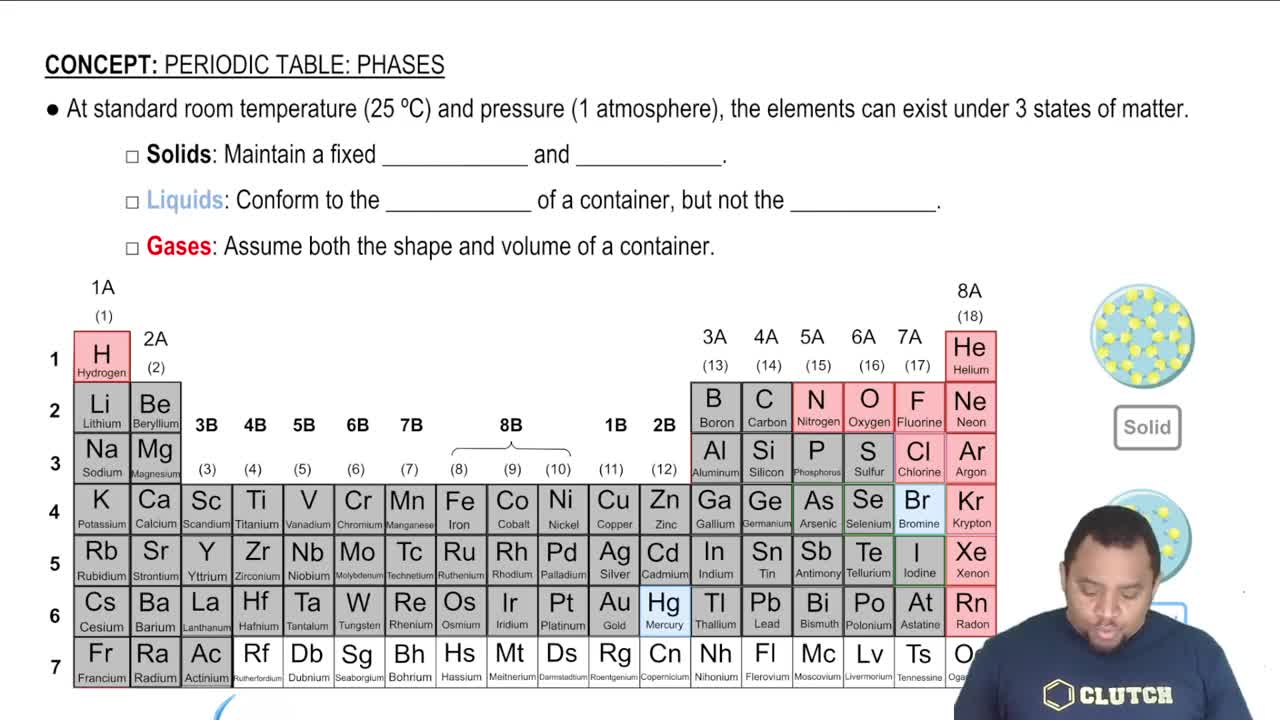
Element States of Matter
관련 실천
교과서 질문
925
views
교과서 질문
Write the balanced chemical equation for each reaction.
c. Sulfur dioxide gas reacts with oxygen gas to form sulfur trioxide gas.
d. Gaseous ammonia (NH3) reacts with gaseous oxygen to form gaseous nitrogen monoxide and gaseous water.
1344
views
교과서 질문
Calculate how many moles of NO2 form when each quantity of reactant completely reacts. 2 N2O5( g) → 4 NO2(g) + O2(g) a. 2.5 mol N2O5
6124
views
교과서 질문
Consider the unbalanced equation for the neutralization of acetic acid: HC2H3O2(aq) + Ba(OH)2(aq) → H2O(l) + Ba(C2H3O2)2(aq) Balance the equation and determine how many moles of Ba(OH)2 are required to completely neutralize 0.461 mole of HC2H3O2.
1999
views
1
rank
교과서 질문
Calculate how many moles of NH3 form when each quantity of reactant completely reacts. 3 N2H4(l) → 4 NH3(g) + N2(g) c. 65.3 g N2H4
1681
views