A balloon contains 0.158 mol of gas and has a volume of 2.46 L. If an additional 0.113 mol of gas is added to the balloon (at the same temperature and pressure), what is its final volume?
Ch.6 - Gases
6장, 문제 32
A sample of gas has an initial volume of 13.9 L at a pressure of 1.22 atm. If the sample is compressed to a volume of 10.3 L, what is its pressure?
검증된 단계별 안내1
Identify the initial conditions: initial volume \( V_1 = 13.9 \text{ L} \) and initial pressure \( P_1 = 1.22 \text{ atm} \).
Identify the final condition: final volume \( V_2 = 10.3 \text{ L} \).
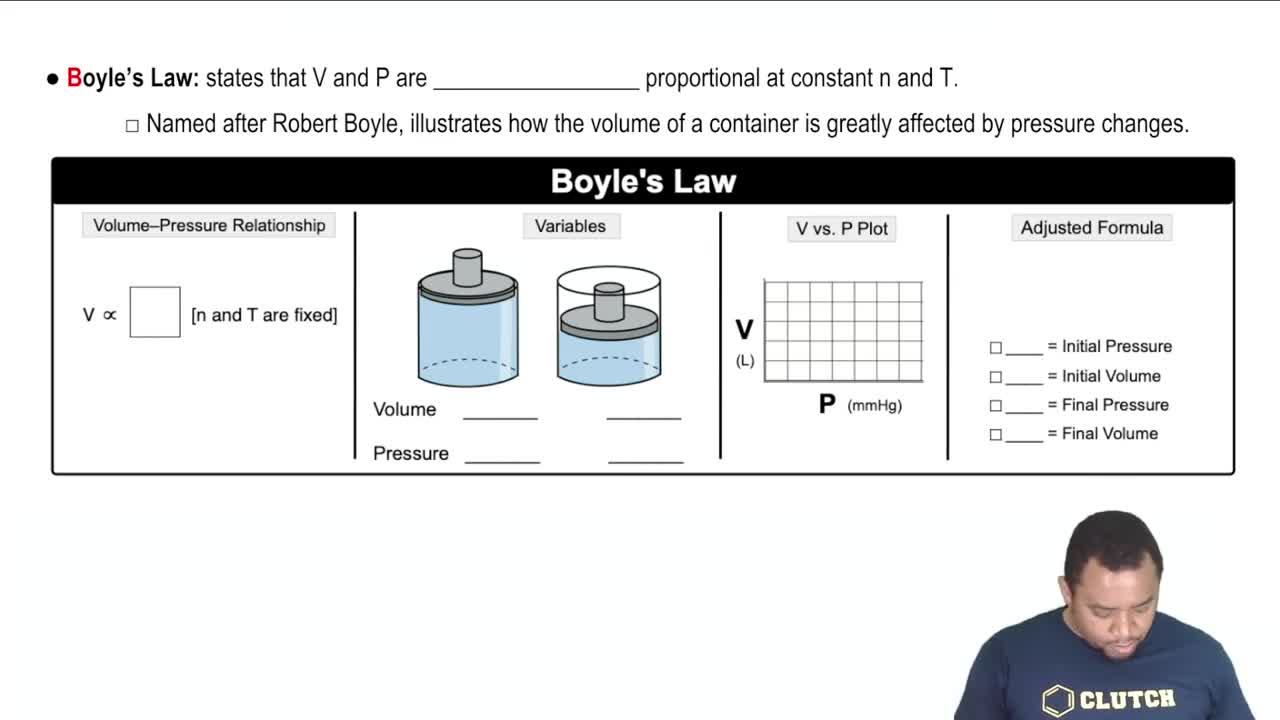
Use Boyle's Law, which states that for a given amount of gas at constant temperature, the pressure of the gas is inversely proportional to its volume: \( P_1 \times V_1 = P_2 \times V_2 \).
Rearrange the equation to solve for the final pressure \( P_2 \): \( P_2 = \frac{P_1 \times V_1}{V_2} \).
Substitute the known values into the equation to find \( P_2 \): \( P_2 = \frac{1.22 \text{ atm} \times 13.9 \text{ L}}{10.3 \text{ L}} \).

비슷한 문제에 대한 검증된 영상 답변:
이 영상 해법은 위 문제에 도움이 된다고 튜터들이 추천한 것입니다.
영상 길이:
1m주요 개념
질문에 올바르게 답하기 위해 반드시 이해해야 하는 핵심 개념들은 다음과 같습니다.
Boyle's Law
Boyle's Law states that the pressure of a gas is inversely proportional to its volume when the temperature and the amount of gas are held constant. This means that if the volume decreases, the pressure increases, and vice versa. The relationship can be expressed mathematically as P1V1 = P2V2, where P1 and V1 are the initial pressure and volume, and P2 and V2 are the final pressure and volume.
추천 영상:
가이드 코스
Boyle's Law
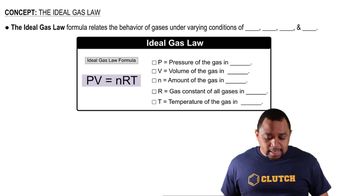
Ideal Gas Law
The Ideal Gas Law combines several gas laws into one equation: PV = nRT, where P is pressure, V is volume, n is the number of moles of gas, R is the ideal gas constant, and T is temperature. While this question primarily uses Boyle's Law, understanding the Ideal Gas Law provides a broader context for gas behavior under varying conditions, especially when considering the effects of temperature and quantity.
추천 영상:
가이드 코스
Ideal Gas Law Formula
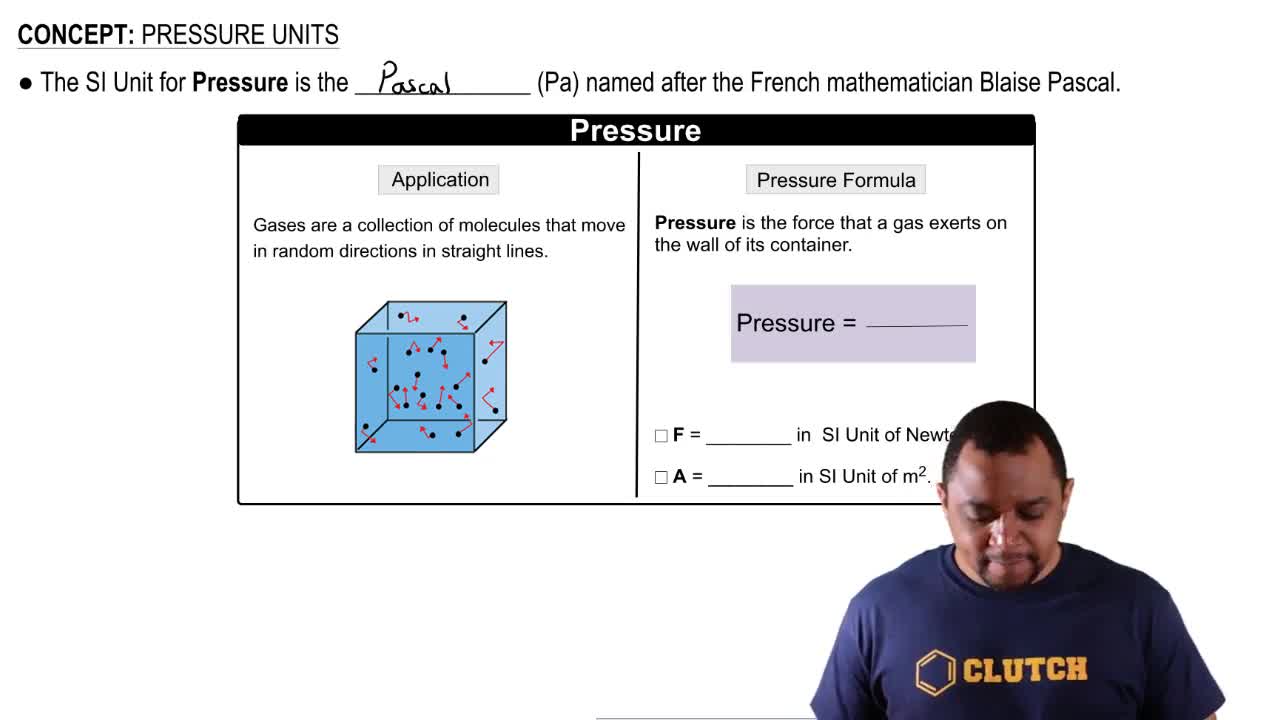
Units of Pressure
Pressure is commonly measured in units such as atmospheres (atm), pascals (Pa), or millimeters of mercury (mmHg). In this question, pressure is given in atmospheres, which is a standard unit in gas law calculations. It's important to ensure that all units are consistent when applying gas laws to avoid calculation errors.
추천 영상:
가이드 코스
Pressure Units
관련 실천
교과서 질문
3618
views
1
rank
교과서 질문
A sample of gas has an initial volume of 5.6 L at a pressure of 735 mmHg. If the volume of the gas is increased to 9.4 L, what is its pressure?
1878
views
교과서 질문
A syringe containing 1.55 mL of oxygen gas is cooled from 95.3 °C to 0.0 °C. What is the final volume of oxygen gas?
2837
views
1
rank
교과서 질문
Given a barometric pressure of 751.5 mmHg, calculate the pressure of each gas sample as indicated by the manometer.
(a)
3686
views
1
comments
교과서 질문
Given a barometric pressure of 751.5 mmHg, calculate the pressure of each gas sample as indicated by the manometer.
(b)
487
views
교과서 질문
A 48.3-mL sample of gas in a cylinder is warmed from 22 °C to 87 °C. What is its volume at the final temperature?
2726
views
1
rank
1
comments