Ch.9 - Periodic Properties of the Elements
Tro - Chemistry: A Molecular Approach 5th Edition
Tro5th EditionChemistry: A Molecular ApproachISBN: 9780134874371당신이 사용하는 게 아니라요?교과서 변경
9장, 문제 47c

Name an element in the fourth period (row) of the periodic table with the following: c. three 3d electrons

검증된 단계별 안내
1
Identify the fourth period (row) of the periodic table, which includes elements with principal quantum number n = 4.
Recall that the 3d subshell begins to fill after the 4s subshell, starting with the element Scandium (Sc).
Understand that the 3d subshell can hold a maximum of 10 electrons, and it starts filling from Scandium (Sc) to Zinc (Zn).
Determine the number of 3d electrons for each element in the 3d block, starting from Scandium (Sc) with 1 electron, Titanium (Ti) with 2 electrons, and so on.
Identify the element with three 3d electrons, which is the third element in the 3d block of the fourth period.

비슷한 문제에 대한 검증된 영상 답변:

이 영상 해법은 위 문제에 도움이 된다고 튜터들이 추천한 것입니다.
영상 길이:
46s

주요 개념

질문에 올바르게 답하기 위해 반드시 이해해야 하는 핵심 개념들은 다음과 같습니다.

Periodic Table Structure

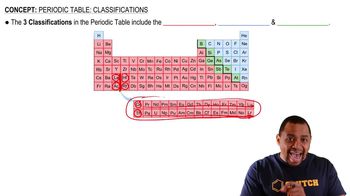
The periodic table is organized into rows (periods) and columns (groups) based on atomic number and electron configuration. Elements in the same period have the same number of electron shells, while groups share similar chemical properties. The fourth period includes elements with atomic numbers 19 (Potassium) to 36 (Krypton), where the filling of the 3d subshell begins.
추천 영상:
가이드 코스
02:40
Periodic Table Classifications

Electron Configuration

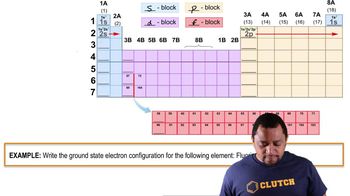
Electron configuration describes the distribution of electrons in an atom's orbitals. For transition metals, the 3d subshell is filled after the 4s subshell. An element with three 3d electrons will have an electron configuration that reflects this, typically seen in transition metals like Scandium (Sc) or Titanium (Ti), which have partially filled d orbitals.
추천 영상:
가이드 코스
01:33
Electron Configuration Example

Transition Metals

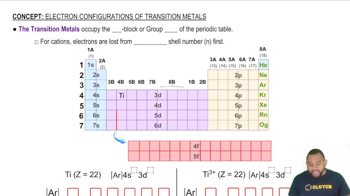
Transition metals are elements found in groups 3 to 12 of the periodic table, characterized by their ability to form variable oxidation states and colored compounds. They typically have partially filled d orbitals, which contribute to their unique properties. In the fourth period, Scandium (Sc) has three 3d electrons, making it a suitable example for the question.
추천 영상:
가이드 코스
03:12
Transition Metals