
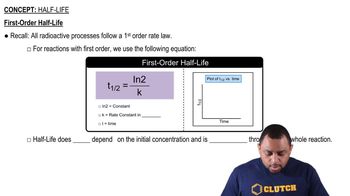
The half-life for the radioactive decay of U-238 is 4.5 billion years and is independent of initial concentration. If a sample of U-238 initially contained 3.2⨉1018 atoms when the universe was formed 13.8 billion years ago, how many U-238 atoms does it contain today?
Ch.15 - Chemical Kinetics

15장, 문제 62a
The decomposition of XY is second order in XY and has a rate constant of 7.02⨉10-3 M-1• s-1 at a certain temperature. a. What is the half-life for this reaction at an initial concentration of 0.100 M?
검증된 단계별 안내1
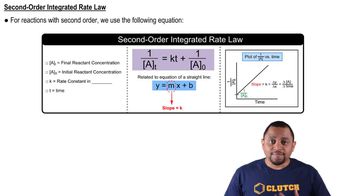
Identify the order of the reaction. Since the decomposition of XY is second order, we will use the second-order half-life formula.
The formula for the half-life \( t_{1/2} \) of a second-order reaction is given by: \[ t_{1/2} = \frac{1}{k[A]_0} \] where \( k \) is the rate constant and \( [A]_0 \) is the initial concentration.
Substitute the given values into the formula: \( k = 7.02 \times 10^{-3} \text{ M}^{-1}\cdot\text{s}^{-1} \) and \( [A]_0 = 0.100 \text{ M} \).
Calculate the half-life using the substituted values. This will involve performing the division to find \( t_{1/2} \).
Interpret the result to understand the time it takes for the concentration of XY to decrease to half of its initial value at the given conditions.

비슷한 문제에 대한 검증된 영상 답변:
이 영상 해법은 위 문제에 도움이 된다고 튜터들이 추천한 것입니다.
영상 길이:
1m주요 개념
질문에 올바르게 답하기 위해 반드시 이해해야 하는 핵심 개념들은 다음과 같습니다.
Second-Order Reactions
Second-order reactions are characterized by a rate that depends on the concentration of one reactant raised to the second power or on the concentrations of two reactants, each raised to the first power. The rate law for a second-order reaction can be expressed as rate = k[A]^2 or rate = k[A][B], where k is the rate constant. Understanding this concept is crucial for determining how the concentration of reactants affects the reaction rate.
추천 영상:
가이드 코스
Second-Order Reactions
Rate Constant (k)
The rate constant (k) is a proportionality factor in the rate law that is specific to a given reaction at a particular temperature. It provides insight into the speed of the reaction; a larger k indicates a faster reaction. For second-order reactions, the units of k are M<sup>-1</sup>•s<sup>-1</sup>, which reflects the relationship between concentration and time in the rate equation.
추천 영상:
가이드 코스
Equilibrium Constant K
Half-Life of a Reaction
The half-life of a reaction is the time required for the concentration of a reactant to decrease to half of its initial value. For second-order reactions, the half-life is inversely proportional to the initial concentration and can be calculated using the formula t<sub>1/2</sub> = 1/(k[A]₀), where [A]₀ is the initial concentration. This relationship is essential for predicting how long it will take for a reactant to diminish in concentration.
추천 영상:
가이드 코스
First-Order Half-Life
관련 실천
교과서 질문
교과서 질문
The half-life for the radioactive decay of C-14 is 5715 years and is independent of the initial concentration. How long does it take for 25.00% of the C-14 atoms in a sample of C-14 to decay?
교과서 질문
The half-life for the radioactive decay of U-238 is 4.5 billion years and is independent of initial concentration. How long will it take for 20% of the U-238 atoms in a sample of U-238 to decay?
교과서 질문
Silver nitrate solutions are often used to plate silver onto other metals. What is the maximum amount of silver (in grams) that can be plated out of 4.8 L of an AgNO3 solution containing 3.4% Ag by mass? Assume that the density of the solution is 1.01 g/mL.
1989
views
