
Ch.4 - Chemical Reactions and Chemical Quantities
Tro - Chemistry: A Molecular Approach 6th Edition
Tro6th EditionChemistry: A Molecular ApproachISBN: 9780137832217당신이 사용하는 게 아니라요?교과서 변경
4장, 문제 57

Urea (CH4N2O) is a common fertilizer that is synthesized by the reaction of ammonia (NH3) with carbon dioxide: 2 NH3(aq) + CO2(aq) → CH4N2O(aq) + H2O(l) In an industrial synthesis of urea, a chemist combines 149.4 kg of ammonia with 231.1 kg of carbon dioxide and obtains 172.3 kg of urea. Determine the limiting reactant, theoretical yield of urea, and percent yield for the reaction.

검증된 단계별 안내
1
Step 1: Convert the masses of ammonia (NH3) and carbon dioxide (CO2) to moles. Use the molar masses: NH3 = 17.03 \(\text{ g/mol}\) and CO2 = 44.01 \(\text{ g/mol}\).
Step 2: Use the balanced chemical equation to determine the mole ratio between NH3 and CO2. The equation is 2 NH3 + CO2 → CH4N2O + H2O, which shows a 2:1 ratio.
Step 3: Calculate the theoretical moles of urea (CH4N2O) that can be produced from each reactant. The limiting reactant will produce the fewer moles of urea.
Step 4: Convert the theoretical moles of urea to mass using its molar mass (CH4N2O = 60.06 \(\text{ g/mol}\)) to find the theoretical yield in kilograms.
Step 5: Calculate the percent yield using the formula: \(\text{Percent Yield}\) = \(\left\)(\(\frac{\text{Actual Yield}\)}{\(\text{Theoretical Yield}\)}\(\right\)) \(\times\) 100\%. Use the actual yield of 172.3 kg of urea.

비슷한 문제에 대한 검증된 영상 답변:

이 영상 해법은 위 문제에 도움이 된다고 튜터들이 추천한 것입니다.
영상 길이:
7m

주요 개념

질문에 올바르게 답하기 위해 반드시 이해해야 하는 핵심 개념들은 다음과 같습니다.

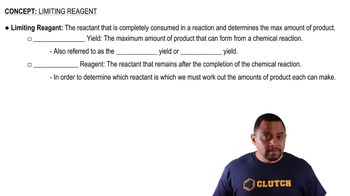
Limiting Reactant

The limiting reactant is the substance that is completely consumed first in a chemical reaction, thus determining the maximum amount of product that can be formed. To identify the limiting reactant, one must compare the mole ratios of the reactants used in the reaction to the stoichiometric coefficients in the balanced equation. The reactant that produces the least amount of product is the limiting reactant.
추천 영상:
가이드 코스
01:30
Limiting Reagent Concept

Theoretical Yield

The theoretical yield is the maximum amount of product that can be generated from a given amount of reactants, based on the stoichiometry of the balanced chemical equation. It is calculated using the moles of the limiting reactant and the molar ratios from the balanced equation. This value represents an ideal scenario without any losses or inefficiencies during the reaction.
추천 영상:
가이드 코스
03:09
Percent Yield in Reactions

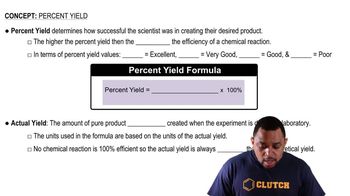
Percent Yield

Percent yield is a measure of the efficiency of a chemical reaction, calculated by taking the actual yield of the product obtained from the reaction and dividing it by the theoretical yield, then multiplying by 100. This metric helps chemists assess how well a reaction proceeds under given conditions and can indicate potential issues in the reaction process or product recovery.
추천 영상:
가이드 코스
03:09
Percent Yield in Reactions