

Ch.4 - Chemical Reactions and Chemical Quantities
Tro - Chemistry: A Molecular Approach 6th Edition
Tro6th EditionChemistry: A Molecular ApproachISBN: 9780137832217당신이 사용하는 게 아니라요?교과서 변경
4장, 문제 65

Write the balanced equation for the reaction of hydrogen gas with bromine gas.

검증된 단계별 안내
1
Identify the reactants: hydrogen gas (H₂) and bromine gas (Br₂).
Determine the product of the reaction: hydrogen bromide (HBr).
Write the unbalanced chemical equation: H₂ + Br₂ → HBr.
Balance the equation by ensuring the number of atoms of each element is the same on both sides. Start by balancing the bromine atoms.
Since there are two bromine atoms in Br₂, place a coefficient of 2 in front of HBr to balance the bromine atoms: H₂ + Br₂ → 2 HBr.

비슷한 문제에 대한 검증된 영상 답변:

이 영상 해법은 위 문제에 도움이 된다고 튜터들이 추천한 것입니다.
영상 길이:
1m

주요 개념

질문에 올바르게 답하기 위해 반드시 이해해야 하는 핵심 개념들은 다음과 같습니다.

Chemical Reactions

A chemical reaction involves the transformation of reactants into products through the breaking and forming of chemical bonds. In this case, hydrogen gas (H₂) and bromine gas (Br₂) react to form hydrogen bromide (HBr). Understanding the nature of reactants and products is essential for writing balanced equations.
추천 영상:
가이드 코스
03:31
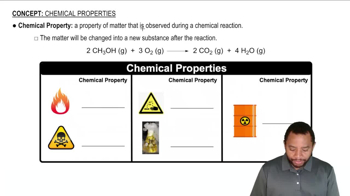
Chemical Properties

Balancing Chemical Equations

Balancing a chemical equation ensures that the number of atoms for each element is the same on both sides of the equation, adhering to the law of conservation of mass. This process often involves adjusting coefficients in front of the chemical formulas to achieve balance, which is crucial for accurately representing the reaction.
추천 영상:
가이드 코스
01:32
Balancing Chemical Equations

Diatomic Molecules

Certain elements, including hydrogen and bromine, naturally exist as diatomic molecules, meaning they form pairs of atoms (H₂ and Br₂) in their elemental state. Recognizing these diatomic molecules is important when writing chemical equations, as it affects the stoichiometry and the coefficients used in the balanced equation.
추천 영상:
가이드 코스
03:10
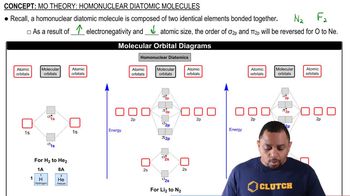
Homonuclear Diatomic Molecules
관련 실천
교과서 질문

Many home barbeques are fueled with propane gas (C3H8). What mass of carbon dioxide (in kg) is produced upon the complete combustion of 37.8 L of propane (approximate contents of one 5-gallon tank)? Assume that the density of the liquid propane in the tank is 0.621 g/mL. (Hint: Begin by writing a balanced equation for the combustion reaction.)

교과서 질문

The combustion of gasoline produces carbon dioxide and water. Assume gasoline to be pure octane (C8H18) and calculate the mass (in kg) of carbon dioxide that is added to the atmosphere per 10.0 kg of octane burned. (Hint: Begin by writing a balanced equation for the combustion reaction.)

교과서 질문

Write the balanced chemical equation for the reaction of solid potassium with liquid water.

633
views
교과서 질문

Write the balanced chemical equation for the reaction of solid strontium with iodine gas.

974
views
교과서 질문

Write the balanced chemical equation for the reaction of solid lithium with liquid water.

862
views
교과서 질문

Aspirin can be made in the laboratory by reacting acetic anhydride (C4H6O3) with salicylic acid (C7H6O3) to form aspirin (C9H8O4) and acetic acid (C2H4O2). The balanced equation is: C4H6O3 + C7H6O3 → C9H8O4 + C2H4O2 In a laboratory synthesis, a student begins with 6.00 mL of acetic anhydride (density= 1.08 g/ mL) and 2.50 g of salicylic acid. Once the reaction is complete, the student collects 1.82 g of aspirin. Determine the limiting reactant, theoretical yield of aspirin, and percent yield forthe reaction.