


Ch.6 - Gases
Tro - Chemistry: A Molecular Approach 6th Edition
Tro6th EditionChemistry: A Molecular ApproachISBN: 9780137832217당신이 사용하는 게 아니라요?교과서 변경
6장, 문제 74

What is the mole fraction of oxygen gas in air (see Table 6.3)? What volume of air contains 20.0 g of oxygen gas at 273 K and 1.00 atm?

검증된 단계별 안내
1
Identify the mole fraction of oxygen gas in air from Table 6.3. Typically, air is composed of approximately 21% oxygen by volume.
Convert the mass of oxygen gas (20.0 g) to moles using the molar mass of oxygen (O_2), which is approximately 32.00 g/mol.
Use the ideal gas law, PV = nRT, to find the volume of oxygen gas. Here, P is the pressure (1.00 atm), V is the volume, n is the number of moles of oxygen, R is the ideal gas constant (0.0821 L·atm/mol·K), and T is the temperature (273 K).
Rearrange the ideal gas law to solve for volume (V): V = nRT/P.
Substitute the values for n, R, T, and P into the equation to calculate the volume of air that contains 20.0 g of oxygen gas.

비슷한 문제에 대한 검증된 영상 답변:

이 영상 해법은 위 문제에 도움이 된다고 튜터들이 추천한 것입니다.
영상 길이:
7m

주요 개념

질문에 올바르게 답하기 위해 반드시 이해해야 하는 핵심 개념들은 다음과 같습니다.

Mole Fraction

Mole fraction is a way of expressing the concentration of a component in a mixture. It is defined as the ratio of the number of moles of a specific component to the total number of moles of all components in the mixture. For example, in air, the mole fraction of oxygen can be calculated by dividing the moles of oxygen by the total moles of all gases present.
추천 영상:
가이드 코스
00:36
Mole Fraction Formula

Ideal Gas Law

The Ideal Gas Law is a fundamental equation in chemistry that relates the pressure, volume, temperature, and number of moles of a gas. It is expressed as PV = nRT, where P is pressure, V is volume, n is the number of moles, R is the ideal gas constant, and T is temperature in Kelvin. This law allows us to calculate the volume of gas under specific conditions, such as the volume of air containing a certain mass of oxygen.
추천 영상:
가이드 코스
01:15
Ideal Gas Law Formula

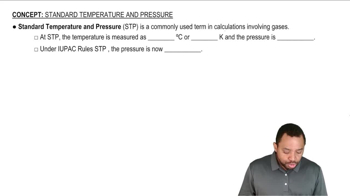
Standard Temperature and Pressure (STP)

Standard Temperature and Pressure (STP) is a reference point used in gas calculations, defined as 0 degrees Celsius (273 K) and 1 atmosphere of pressure. At STP, one mole of an ideal gas occupies a volume of 22.4 liters. This concept is crucial for determining the volume of gases in various conditions, including calculating how much air is needed to contain a specific mass of oxygen.
추천 영상:
가이드 코스
01:08
Standard Temperature and Pressure
관련 실천
교과서 질문

A 275-mL flask contains pure helium at a pressure of 752 torr. A second flask with a volume of 475 mL contains pure argon at a pressure of 722 torr. If we connect the two flasks through a stopcock and we open the stopcock, what is the partial pressure of argon?

3192
views
교과서 질문

The hydrogen gas formed in a chemical reaction is collected over water at 30.0 °C at a total pressure of 732 mmHg. What is the partial pressure of the hydrogen gas collected in this way? If the total volume of gas collected is 722 mL, what mass of hydrogen gas is collected?

4586
views
1
comments
교과서 질문

The zinc in a copper-plated penny will dissolve in hydrochloric acid if the copper coating is filed down in several spots (so that the hydrochloric acid can get to the zinc). The reaction between the acid and the zinc is 2 H+(aq) + Zn(s) → H2(g) + Zn2+(aq). When the zinc in a certain penny dissolves, the total volume of gas collected over water at 25 °C is 0.951 L at a total pressure of 748 mmHg. What mass of hydrogen gas is collected?

3332
views
교과서 질문

A gas mixture contains 1.05 g N2 and 1.35 g O2 in a 1.35-L container at 15°C. Calculate the mole fraction and partial pressure of each component in the gas mixture.

2
views
교과서 질문

A 1.20-g sample of dry ice is added to a 755 mL flask containing nitrogen gas at a temperature of 25.0 °C and a pressure of 725 mmHg. The dry ice sublimes (converts from solid to gas), and the mixture returns to 25.0 °C. What is the total pressure in the flask?

2978
views
교과서 질문

The air in a bicycle tire is bubbled through water and collected at 25 °C. If the total volume of gas collected is 5.45 L at a temperature of 25 °C and a pressure of 745 torr, how many moles of gas were in the bicycle tire?

1692
views