


Ch.6 - Gases
Tro - Chemistry: A Molecular Approach 6th Edition
Tro6th EditionChemistry: A Molecular ApproachISBN: 9780137832217당신이 사용하는 게 아니라요?교과서 변경
6장, 문제 44

What is the pressure in a 19.0-L cylinder filled with 34.3 g of oxygen gas at a temperature of 312 K?

검증된 단계별 안내
1
Identify the relevant variables from the problem: volume (V) = 19.0 L, mass of oxygen gas (m) = 34.3 g, temperature (T) = 312 K.
Calculate the number of moles of oxygen gas (n) using the molar mass of oxygen (O2), which is approximately 32.00 g/mol. Use the formula: n = m / molar mass.
Use the ideal gas law equation, PV = nRT, where P is the pressure, V is the volume, n is the number of moles, R is the ideal gas constant (0.0821 L\(\cdot\)atm/mol\(\cdot\)K), and T is the temperature in Kelvin.
Substitute the values for n, V, R, and T into the ideal gas law equation to solve for P (pressure).
Ensure that all units are consistent (e.g., volume in liters, temperature in Kelvin, pressure in atm) when performing calculations.

비슷한 문제에 대한 검증된 영상 답변:

이 영상 해법은 위 문제에 도움이 된다고 튜터들이 추천한 것입니다.
영상 길이:
5m

주요 개념

질문에 올바르게 답하기 위해 반드시 이해해야 하는 핵심 개념들은 다음과 같습니다.

Ideal Gas Law

The Ideal Gas Law is a fundamental equation in chemistry that relates the pressure, volume, temperature, and number of moles of a gas. It is expressed as PV = nRT, where P is pressure, V is volume, n is the number of moles, R is the ideal gas constant, and T is temperature in Kelvin. This law allows us to calculate the pressure of a gas when the other variables are known.
추천 영상:
가이드 코스
01:15
Ideal Gas Law Formula

Molar Mass

Molar mass is the mass of one mole of a substance, typically expressed in grams per mole (g/mol). For oxygen (O2), the molar mass is approximately 32.00 g/mol. Understanding molar mass is essential for converting grams of a substance to moles, which is necessary for using the Ideal Gas Law effectively.
추천 영상:
가이드 코스
02:11
Molar Mass Concept

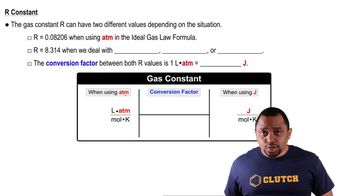
Gas Constant (R)

The gas constant (R) is a proportionality constant in the Ideal Gas Law that relates the energy scale to the temperature scale. Its value is typically 0.0821 L·atm/(K·mol) when pressure is measured in atmospheres and volume in liters. Knowing the correct value of R is crucial for accurate calculations involving gas behavior under various conditions.
추천 영상:
가이드 코스
01:56
Gas Constant Values
관련 실천
교과서 질문

An automobile tire has a maximum rating of 38.0 psi (gauge pressure). The tire is inflated (while cold) to a volume of 11.8 L and a gauge pressure of 36.0 psi at a temperature of 12.0 °C. On a hot day, the tire warms to 65.0 °C, and its volume expands to 12.2 L. Does the pressure in the tire exceed its maximum rating? (Note: The gauge pressure is the difference between the total pressure and atmospheric pressure. In this case, assume that atmospheric pressure is 14.7 psi.)

1711
views
교과서 질문

What volume is occupied by 12.5 g of argon gas at a pressure of 1.05 atm and a temperature of 322 K? Would the volume be different if the sample were 12.5 g of helium (under identical conditions)?

1838
views
1
comments
교과서 질문

What volume is occupied by 0.118 mol of helium gas at a pressure of 0.97 atm and a temperature of 305 K?

817
views
교과서 질문

What volume is occupied by 0.118 mol of helium gas at a pressure of 0.97 atm and a temperature of 305 K? Would the volume be different if the gas was argon (under the same conditions)?

1929
views
1
rank
교과서 질문

A weather balloon is inflated to a volume of 28.5 L at a pressure of 748 mmHg and a temperature of 28.0 °C. The balloon rises in the atmosphere to an altitude of approximately 25,000 ft, where the pressure is 385 mmHg and the temperature is -15.0 °C. Assuming the balloon can freely expand, calculate the volume of the balloon at this altitude.

6407
views
2
rank
교과서 질문

What is the temperature of 3.05 g of helium gas at a pressure of 1.70 atm and a volume of 14.1 L?