뒤로

exam 2

컨트롤 버튼이 '내비게이션' 모드로 변경되었습니다.
1/20
  • What are the nine general features of the genetic code?

    1. Triplet code (3 bases = 1 amino acid)
    2. Nonoverlapping
    3. Commaless/continuous
    4. Unambiguous
    5. Degenerate (redundant)
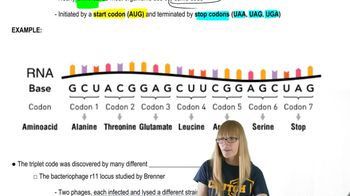
    6. Start (AUG) and stop codons (UAA, UAG, UGA)
    7. Nearly universal
    8. Read 5′→3′, protein grows N→C
    9. Wobble at third base
  • Define reading frame and its significance.

    Reading frame is how ribosomes group mRNA bases into triplets. There are 3 possible frames on one strand. A frameshift changes all downstream codons, often producing a different or truncated protein.
  • How did Nirenberg and Matthaei decipher the genetic code using a cell-free system?

    They used in vitro translation with synthetic RNAs. Poly-U RNA produced polypeptides of phenylalanine, showing UUU codes for Phe. Other homopolymers helped map more codons.
  • What is the triplet binding assay by Nirenberg and Leder?

    A ribosome + synthetic trinucleotide + aminoacyl-tRNAs were used. If a tRNA matched the codon, it bound the complex and was detected, allowing codon assignments without full polypeptides.
  • How did Khorana's experiments help finish deciphering the genetic code?

    He synthesized repeating RNAs with defined patterns. Translation produced repeating amino acid patterns depending on reading frame, allowing assignment of remaining codons.
  • How to determine polypeptide from a given DNA single strand?

    (i) Identify if strand is template or coding.
    (ii) Complementary DNA is antiparallel with A–T, C–G.
    (iii) mRNA matches coding strand with U replacing T.
    (iv) Find AUG start codon, translate until stop.
  • Describe the structure and function of tRNA.

    tRNA is an adaptor with an anticodon loop (3 bases pairing with codon) and a 3′ CCA acceptor stem where amino acid attaches. Its L-shaped 3D structure positions these sites for translation.
  • How are uncharged tRNAs charged with amino acids?

    Aminoacyl-tRNA synthetase attaches amino acid in two steps: (1) amino acid + ATP → aminoacyl-AMP + PPi; (2) transfer to tRNA 3′ end → charged tRNA + AMP. This ensures accuracy.
  • What is the third-base wobble in the genetic code?

    Flexible base-pairing between the 3rd codon base and 1st anticodon base allows one tRNA to recognize multiple codons differing at the third position, explaining degeneracy.
  • What are the main functional sites of the ribosome in translation?

    A site: aminoacyl-tRNA entry
    P site: peptidyl-tRNA holds growing chain
    E site: exit of empty tRNA
    Small subunit decodes codon; large subunit catalyzes peptide bond.
  • List the key molecular components involved in prokaryotic translation.

    mRNA (template), ribosome (30S + 50S), tRNAs, aminoacyl-tRNA synthetases, initiation factors (IF1, IF2, IF3), elongation factors (EF-Tu, EF-Ts, EF-G), release factors (RF1, RF2, RF3), ATP and GTP energy.
  • Outline the steps of prokaryotic translation initiation.

    IF1 and IF3 bind small subunit sites; Shine-Dalgarno sequence recognized; initiator fMet-tRNA binds P site; IF2 hydrolyzes GTP; large subunit joins forming 70S complex.
  • Describe the elongation cycle in prokaryotic translation.

    EF-Tu-GTP delivers charged tRNA to A site; GTP hydrolyzed; peptide bond forms; EF-G-GTP hydrolyzes GTP to translocate ribosome; empty tRNA exits E site.
  • Explain termination and ribosome recycling in prokaryotic translation.

    Stop codon in A site recruits release factor; polypeptide released; RF3-GTP hydrolyzes GTP; ribosome recycling factor (RRF) and EF-G-GTP disassemble complex; EF-Ts regenerates EF-Tu-GTP.
  • Compare translation initiation in prokaryotes and eukaryotes.

    Prokaryotes use Shine-Dalgarno sequence and fMet initiator; eukaryotes use 5′ cap scanning with Kozak sequence and Met initiator. Ribosomes are 70S in prokaryotes, 80S in eukaryotes.
  • How does transcription differ from translation in prokaryotes?

    Transcription makes RNA from DNA; translation makes protein from mRNA. In prokaryotes, these can be coupled; mRNA has minimal processing and no nucleus compartmentalization.
  • What is the role of aminoacyl-tRNA synthetases in translation?

    They charge tRNAs with the correct amino acids, ensuring accuracy by recognizing both amino acid and tRNA identity elements, often with proofreading.
  • What is the significance of the Shine-Dalgarno sequence?

    It is a ribosomal binding site on prokaryotic mRNA that aligns the ribosome with the start codon for correct translation initiation.
  • What is the function of the ribosome's peptidyl transferase activity?

    It catalyzes peptide bond formation between amino acids during protein elongation; this activity is performed by rRNA, making the ribosome a ribozyme.
  • How does the ribosome ensure correct codon-anticodon pairing?

    The small subunit decodes the mRNA codon by checking base pairing with the tRNA anticodon, ensuring accurate amino acid incorporation.