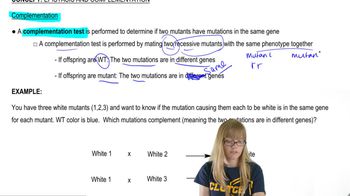
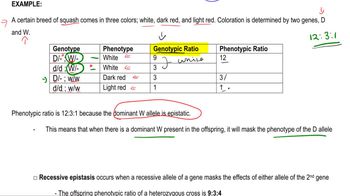
To determine whether mutations are in the same gene or in different genes by testing if two mutations complement each other in a diploid organism.
Define a population in genetics.
A group of interbreeding organisms sharing a common gene pool.
What is a gene pool?
The collection of all genes and alleles present in the members of a population.
What conditions define Hardy-Weinberg equilibrium?
An infinitely large population, random mating, and no evolutionary change, where allele and genotype frequencies remain constant.
What does the Hardy-Weinberg equation model?
It calculates allele and genotype frequencies in a theoretical population under equilibrium conditions.
Name three methods to calculate allele frequencies using Hardy-Weinberg principles.
Genotype proportion, allele counting, and square root methods.
Define euploidy.
A chromosomal condition where the organism has a complete set of chromosomes.
Define aneuploidy.
A chromosomal condition where the organism has an abnormal number of chromosomes, such as trisomy or monosomy.
What is trisomy?
The presence of an extra chromosome, resulting in three copies of a particular chromosome.
What is monosomy?
The presence of only one copy of a particular chromosome instead of the usual two.
Explain gene dosage.
The number of copies of a gene present in a cell, which can affect phenotype when altered.
What is mosaicism?
The presence of two or more genetically different cell lines in one individual, often due to mitotic nondisjunction.
Describe uniparental disomy.
A condition where both copies of a chromosome come from one parent instead of one from each.
What is trisomic rescue?
A process where a trisomic zygote loses one chromosome to restore a normal chromosome number.
What is the difference between paracentric and pericentric inversions?
Paracentric inversions do not include the centromere; pericentric inversions include the centromere.
What are the gamete outcomes of paracentric inversions?
Two normal gametes and two gametes with deletions that are not viable.
What are the gamete outcomes of pericentric inversions?
Two normal gametes and two gametes with duplications and deletions that are not viable.
Define organelle inheritance.
Transmission of genes located in mitochondria or chloroplasts, separate from nuclear chromosomes.
What is homoplasmy?
A cell or organism where all copies of an organelle gene are identical.
What is heteroplasmy?
A cell or organism containing a mixture of different organelle gene copies.
What is replicative segregation in organelle inheritance?
Random segregation of organelles during cell division affecting the proportion of mutant and wild-type genomes.
How does mitochondrial inheritance occur in mammals?
Strictly maternally inherited with no recombination; all offspring inherit mitochondrial DNA from the mother.
What is the significance of the 'mitochondrial Eve'?
The most recent common maternal ancestor from whom all current human mitochondrial DNA descends.
Why is the mitochondrial mutation rate higher than nuclear DNA?
Mitochondrial DNA has a mutation rate about 10 times greater due to less efficient repair mechanisms.
What is the endosymbiosis theory?
The theory that mitochondria and chloroplasts originated from free-living bacteria that formed symbiotic relationships with eukaryotic cells.
List evidence supporting the endosymbiosis theory.
Double membranes, bacterial size, bacterial-like DNA packaging, bacterial transcription/translation machinery, and protein-coding sequences similar to bacteria.
What must transferred organelle genes acquire to function in the nucleus?
Sequences for correct nuclear expression and an amino terminal signal for protein transport back to the organelle.
What is the nucleoid in organelles?
The region where organelle DNA is packaged into protein-DNA complexes, containing multiple genome copies.
How can FISH be used in chromosome aberration studies?
Fluorescent in situ hybridization (FISH) detects deletions or duplications by labeling specific DNA sequences on chromosomes.
 뒤로
 07:10