 뒤로
Gene Regulation in Bacteria - lac and trp Operons
 04:27

이 집합의 용어 (21)
Gene regulation is the process by which bacteria turn specific genes on or off depending on metabolic needs and environmental changes to conserve energy.
Constitutive genes are always expressed; inducible genes are expressed only when needed, such as enzymes produced in response to specific substrates.
Gene regulation occurs at transcriptional, translational, and post-translational levels.
Positive control: activator protein stimulates transcription.
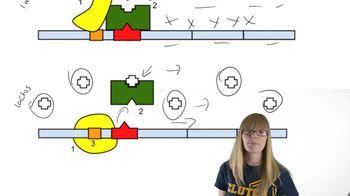
Negative control: repressor protein blocks transcription unless removed.
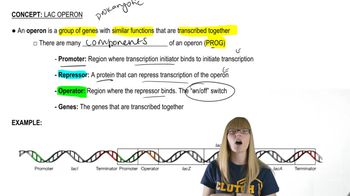
The lac operon is a gene cluster in E. coli that encodes proteins for lactose metabolism, including β-galactosidase, permease, and transacetylase.
β-galactosidase cleaves lactose into glucose and galactose for energy production.
X-gal is a synthetic substrate cleaved by β-galactosidase, releasing a blue color indicating enzyme activity.
lacZ encodes β-galactosidase, lacY encodes permease, and lacA encodes transacetylase.
Cis-elements like the promoter and operator are DNA sequences near the genes.
Trans-elements like the lacI repressor protein act diffusely on DNA.
Lactose binds the lac repressor, causing it to dissociate from the operator, allowing transcription to proceed.
IPTG is a synthetic inducer that binds the lac repressor but is not metabolized, maintaining operon induction.
The lac operator is cis-acting, affecting only genes on the same DNA molecule where it is located.
The lac repressor is trans-acting, able to regulate operons on different DNA molecules within the same cell.
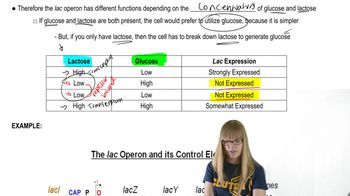
Glucose inhibits adenylate cyclase, lowering cAMP levels, which reduces CAP activation and represses lac operon transcription.
CAP binds cAMP and activates lac operon transcription by facilitating RNA polymerase binding to the promoter.
When lactose is present and glucose is absent, allowing repressor release and CAP activation.
The trp operon encodes enzymes for tryptophan biosynthesis and is regulated by repression when tryptophan is abundant.
The trp operon is repressible and turned off by a co-repressor (tryptophan), while the lac operon is inducible and turned on by an inducer (lactose).
The trp repressor is an aporepressor that binds the operator only when complexed with tryptophan (co-repressor).
The repressor does not bind the operator, allowing transcription and synthesis of tryptophan biosynthesis enzymes.
The tryptophan-aporepressor complex binds the operator, repressing transcription and stopping tryptophan synthesis.