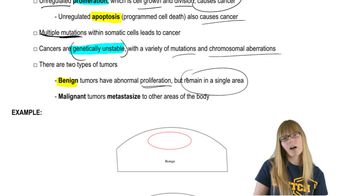
What are the two fundamental properties shared by cancer cells?
Unregulated cell proliferation and metastatic spread distinguish cancer cells from healthy cells.
Difference between benign and malignant tumors
Benign tumors are unregulated growths that do not invade other tissues and can be removed safely. Malignant tumors metastasize, invade other tissues, and cause life-threatening problems.
Is cancer a genetic disease? If so, at what level?
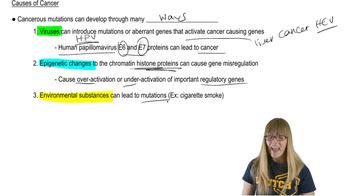
Cancer is a genetic disease caused mostly by mutations in somatic cells, with only about 5% linked to germ-line mutations.
What is genomic instability in cancer cells?
Cancer cells have a mutator phenotype with high genomic instability, including translocations, aneuploidy, chromosome loss, DNA amplification, and deletions.
What are double-minute chromosomes?
Double-minute chromosomes are small, extrachromosomal DNA fragments that contain amplified oncogenes in cancer cells.
What is the Philadelphia chromosome and its significance?
The Philadelphia chromosome results from a reciprocal translocation between chromosomes 9 and 22 and is associated with chronic myelogenous leukemia (CML).
What does it mean that cancer cells are clonal?
All cancer cells in a tumor originate from a single ancestral cell that accumulated multiple mutations.
Why is cancer considered a multistep process?
Cancer develops through the accumulation of multiple mutations over time, not from a single mutation.
What is the difference between driver and passenger mutations in cancer?
Driver mutations confer growth advantages to tumor cells, while passenger mutations do not directly contribute to cancer but accumulate due to genomic instability.
Which cellular functions are affected by cancer-causing mutations?
Mutations affect DNA repair, cell cycle control, apoptosis, cellular differentiation, and cell adhesion.
How is the cell cycle regulated in normal cells?
Cell cycle progression is controlled by cyclins and cyclin-dependent kinases (CDKs) at checkpoints G1/S, G2/M, and M.
What happens to cell cycle regulation in cancer cells?
Mutations or misexpression of cyclins and CDKs cause uncontrolled proliferation and failure to enter the quiescent G0 phase.
What is apoptosis and its role in cancer prevention?
Apoptosis is programmed cell death triggered by severe DNA damage, eliminating damaged cells and reducing cancer risk.
Define proto-oncogenes and tumor suppressor genes.
Proto-oncogenes promote cell growth and division; tumor suppressor genes regulate checkpoints and apoptosis to prevent uncontrolled growth.
How do proto-oncogenes become oncogenes?
Proto-oncogenes mutate or become overexpressed (gain-of-function), leading to constant activation and uncontrolled cell division.
What is the effect of a gain-of-function mutation in a CDK gene?
It causes continuous activation of the CDK, leading to uncontrolled cell cycle progression and proliferation.
What role does the p53 protein play in cancer prevention?
p53 is a tumor suppressor that induces cell cycle arrest, DNA repair, or apoptosis in response to DNA damage.
What happens to p53 function in many cancers?
p53 is often mutated or inactivated, preventing cell cycle arrest and apoptosis, allowing damaged cells to proliferate.
How do cancer cells metastasize?
Cancer cells detach, enter blood or lymph, and invade new tissues; metastasis involves genes controlling adhesion, cytoskeleton, and proteolysis.
What are the hallmarks of many cancer cells?
Failure to undergo apoptosis, genomic instability, uncontrolled cell division, and reduced DNA repair capacity.
 뒤로
 08:34